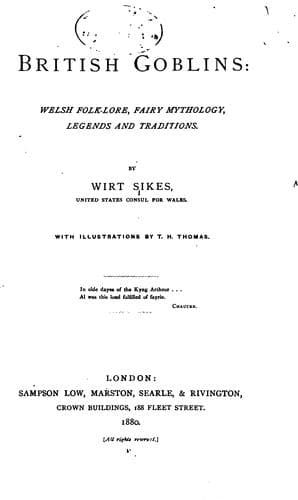
British Goblins: Welsh Folk-lore, Fairy Mythology, Legends and TraditionsSikes, Wirt
History
British Goblins: Welsh Folk-lore, Fairy Mythology, Legends and Traditions
Sikes, Wirt
Folklore -- Wales; Goblins -- Wales; Mythology, Celtic -- Wales; Mythology, Welsh; Wales -- Social life and customs
The ghosts of Wales present many well-defined features. It is even
possible to classify them, after a fashion. Of course, as with all
descriptions of phantoms, the vagueness inevitable in creatures of the
imagination is here; but the ghosts of Welsh tradition are often so
old, and have been handed down so cleanly through successive
generations, that in our day they have almost acquired definite
outlines, as in the case of images arising from the perceptions.
Always bearing in mind the risk of being lost in the labyrinthine
eccentricities of popular fancy, compared to which the Arsinoë of
Herodotus was unperplexing, I venture to classify the inhabitants of
the Welsh spirit-world thus: 1. Departed Mortals; 2. Goblin Animals;
3. Spectres of Natural Objects; 4. Grotesque Ghosts; 5. Familiar
Spirits; 6. Death Omens.
IV.
The ghosts of departed mortals are usually the late personal
acquaintances of the people who see them. But sometimes they are
strangers whom nobody knows, and concerning whom everybody is curious.
Two such ghosts haunted the streets of Ebbw Vale, in Glamorganshire,
in January, 1877. One was in the shape of an old woman, the other in
that of a girl child. Timid people kept indoors after nightfall, and
there were many who believed thoroughly in the ghostly character of
the mysterious visitors. Efforts were made to catch them, but they
eluded capture. It was hinted by materialists that they were thieves;
by unbelievers in spiritualism that they had perhaps escaped from a
seance in some adjoining town. These ghosts, however, are not very
interesting. A cultivated moderner can have no satisfaction in forming
the acquaintance of a seance ghost; it is quite otherwise in the case
of a respectable old family goblin which has haunted a friend's house
in the most orthodox manner for centuries. Such ghosts are numerous in
Wales, and quite faithfully believed in by selected individuals.
Indeed one of the highest claims to a dignified antiquity that can be
put in by a Welsh family mansion, is the possession of a good
old-fashioned blood-curdling spectre--like that, for example, which
has haunted Duffryn House, a handsome stone manse near Cardiff, for
the past two hundred years and more. This is the ghost of the doughty
admiral Sir Thomas Button, famed in his day as an Arctic navigator.
Since his death he has faithfully haunted (so the local farm folk say)
the cellar and the garden of Duffryn House, where he lived, when he
did live, which was in the 17th century. He has never been known to
appear in hall or chamber of the mansion, within the memory of man,
but has been seen hovering over the beer butt or tun in the cellar,
commemorated in his name, and walking in the flower-garden of a fine
windy night.
It is noteworthy that in Wales it is by no means necessary that a
house should be tenantless, mortally speaking, merely because a ghost
haunts it. The dreary picture of desolation drawn by Hood, the
all-sufficient explanation of which was--
Public-domain text, read in full here on John Shaqi.
Reviews
Reviews
No reviews yet
Be the first to share your thoughts on this work.
Elsewhere in the archive
Join the Discussion
Join the discussion
Sign in to leave a comment or review.
Sign InorCreate an account