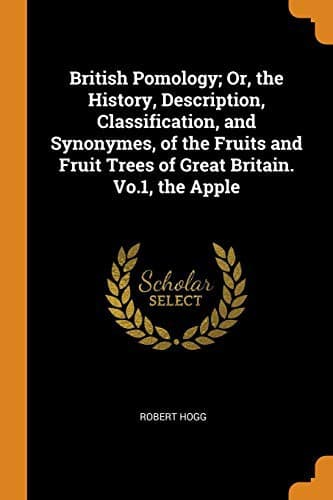
British Pomology: Or, the History, Description, Classification, and Synonymes, of the Fruits and Fruit Trees of Great BritainHogg, Robert
History
British Pomology: Or, the History, Description, Classification, and Synonymes, of the Fruits and Fruit Trees of Great Britain
Hogg, Robert
Apples
A great desideratum in pomological science is, a system of
classification for the apple, founded on characters which are at once
permanent and well defined. The Germans have been most assiduous
in endeavoring to attain this object, and many systems have been
suggested, of which those of Manger, Sickler, Christ, and Diel, are
most generally known. But it is to Diel that the greatest merit is
due, for having produced a system, which, though far from perfect, is
greatly in advance of any which had hitherto been produced; and which
has been universally adopted by all the German pomologists. In 1847,
my friend Dochnahl, an eminent and assiduous pomologist, published a
system, based upon that of Diel, of which it is a modification, and
which possesses such advantages over its type, as to be more easily
reduced to practise.
As the systems of Diel and Dochnahl, are certainly the best which have
yet appeared, I have introduced them here, for the benefit of those who
may want a groundwork on which to form an arrangement.
DIEL’S CLASSIFICATION.
CLASS I. RIBBED APPLES.
1. They are furnished with very prominent, but regular ribs round the
eye, extending also over the fruit, but which do not render the shape
irregular.--2. Having wide, open, and very irregular cells.
ORDER I. TRUE CALVILLES.
1. They taper from about the middle of the fruit towards the eye.--2.
They are covered with bloom when on the tree.--3. They have, or acquire
by keeping, an unctuous skin.--4. They are not distinctly and purely
striped.--5. They have light, spongy, delicate flesh.--6. They have a
strawberry or raspberry flavor.
ORDER II. SCHLOTTERÄPFEL.
1. The skin does not feel unctuous.--2. They are not covered with
bloom.--3. They are either of a flat, conical, cylindrical, or tapering
form.--4. They have not a balsamic, but mostly a sweetish or sourish
flavor.--5. They have a granulous, loose, and coarse-grained flesh.
ORDER III. GULDERLINGE.
1. They are not balsamic like Order I., but of an aromatic flavor.--2.
They have a fine flesh, almost like that of the Reinettes.--3. They are
either of a conical or flat shape.--4. They are most prominently ribbed
round the eye.
CLASS II. ROSENÄPFEL.--ROSE APPLES.
1. They are covered with blue bloom when on the tree.--2. They have
not unproportionally large, but often only regular cells.--3. They
emit a pleasant odor when briskly rubbed.--4. The skin does not feel
unctuous.--5. They are handsomely and regularly ribbed round the eye,
and often also over the fruit.--6. They have a tender, loose, spongy,
and mostly fine-grained flesh.--7. They have a fine rose, fennel, or
anise flavor.--8. They are mostly of short duration, and are often only
summer, or autumn apples.--9. They are mostly striped like a tulip.
ORDER I. FRUIT TAPERING OR OBLONG.
ORDER II. FRUIT ROUND OR FLAT.
CLASS III. RAMBOURS.
Public-domain text, read in full here on John Shaqi.
Reviews
Reviews
No reviews yet
Be the first to share your thoughts on this work.
Join the Discussion
Join the discussion
Sign in to leave a comment or review.
Sign InorCreate an account