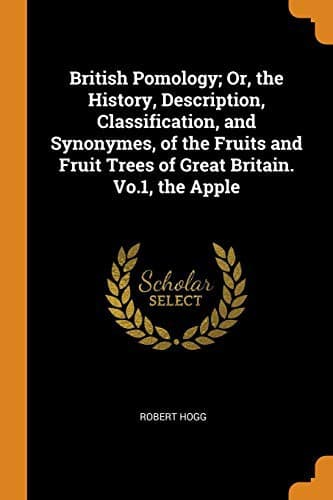
British Pomology: Or, the History, Description, Classification, and Synonymes, of the Fruits and Fruit Trees of Great BritainHogg, Robert
History
British Pomology: Or, the History, Description, Classification, and Synonymes, of the Fruits and Fruit Trees of Great Britain
Hogg, Robert
Apples
IDENTIFICATION.--Lang. Pom. 134. Mill. Dict. Fors. Treat. 129. Lind.
Guide, 100. Hort. Soc. Cat. ed. 3, n. 753. Diel Kernobst. xi. 109.
Rog. Fr. Cult. 107.
Fruit, medium sized, two inches and three quarters broad, and two
inches and a quarter high; roundish-oblate, and somewhat irregular in
its outline. Skin, entirely covered with pale yellowish-grey russet;
with redish-brown where exposed to the sun, strewed with russety
freckles. Eye, small and closed, with short segments, set in a wide,
and undulated basin. Stalk, from a quarter to half-an-inch long,
inserted in a round, narrow, and deep cavity. Flesh, greenish-white,
firm, juicy, brisk, and sugary, with a rich, vinous, and aromatic
flavor.
A valuable, and highly flavored dessert apple of the first quality;
it is in use from November to April; and as Mr. Lindley says, when
ripened, and begins to shrivel, it is one of the best russets of its
season.
The tree is a free grower, healthy, and hardy, but does not attain
above the middle size. It is generally a good bearer, and succeeds well
in almost any soil, provided it be not too moist.
This apple was raised by James Wheeler, the founder of the Gloucester
nursery, now in the occupation of his grandson, Mr. J. Cheslin Wheeler.
He was an intelligent and assiduous man in his profession, and
published in 1763, “The Botanist’s and Gardener’s New Dictionary.” He
died about the beginning of the present century, having attained over
ninety years of age.
378. WHEELER’S EXTREME.--Forsyth.
IDENTIFICATION.--Fors. Treat. 129.
Fruit, small, nearly two inches wide, and one inch and a quarter high;
oblate, much resembling the Api in shape. Skin, pale greenish-yellow,
considerably marked with russet, particularly round the eye; and
covered with fine clear red, which is mottled with deeper red, on the
side next the sun. Eye, small and closed, set in a shallow basin.
Stalk, very short, inserted in a small, shallow cavity. Flesh,
yellowish-white, crisp, tender, sweet, and delicately perfumed.
A pretty little dessert apple, but not of first-rate quality; it is in
use from November to February.
This, as well as the preceding, was raised by James Wheeler, of
Gloucester. The original tree is still existing in the nursery of
his grandson, to whom I am much indebted for several pomological
favors. The name of “Extreme,” is supposed to have been applied to
this variety, from the circumstance of producing its fruit on the
extremities of the last year’s shoots.
379. WHITE ASTRACHAN.--Hort.
IDENTIFICATION.--Hort. Soc. Cat. ed. 3, n. 18. Lind. Guide, 7. Down.
Fr. Amer, 78.
Public-domain text, read in full here on John Shaqi.
Reviews
Reviews
No reviews yet
Be the first to share your thoughts on this work.
Elsewhere in the archive
Join the Discussion
Join the discussion
Sign in to leave a comment or review.
Sign InorCreate an account