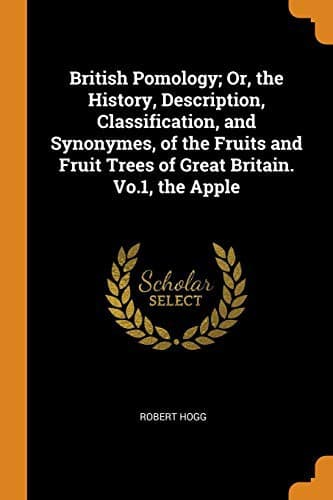
British Pomology: Or, the History, Description, Classification, and Synonymes, of the Fruits and Fruit Trees of Great BritainHogg, Robert
History
British Pomology: Or, the History, Description, Classification, and Synonymes, of the Fruits and Fruit Trees of Great Britain
Hogg, Robert
Apples
Fruit, large, three inches and a quarter wide, and two inches and three
quarters high; roundish, ribbed on the sides, and almost the same width
at the apex as the base. Skin, yellow tinged with green, and strewed
with brown dots on the shaded side; but with a tinge of brown, and
numerous embedded pearly specks on the side next the sun. Eye, large
and open, with broad, flat segments, set in a wide, deep, and rather
angular basin. Stalk, three quarters of an inch long, inserted in a
rather shallow cavity, which is slightly marked with russet. Flesh,
yellowish, slightly tinged with green at the margin, tender, juicy,
sugary, slightly perfumed, and pleasantly flavoured.
Unlike the majority of American Apples, this comes to great perfection
in this country, and is a valuable and first-rate culinary apple. It is
ripe in October and will last till Christmas.
This is the true Fall Pippin of the American orchards, and a very
different variety from the Fall Pippin of this country, which is known
by the names of Cobbett’s Fall Pippin, and Reinette Blanche d’Espagne.
5. AMERICAN SUMMER PEARMAIN.--Ken.
IDENTIFICATION.--Ken. Amer. Or. 1. Hort Soc. Cat. ed. 3. Down. Fr.
Amer. 70.
SYNONYME.--Early Summer Pearmain, _Coxe. View_, 104.
Fruit, medium sized; oblong, regularly and handsomely shaped. Skin,
yellow, covered with patches and streaks of light red, on the shaded
side; and streaked with fine bright red, interspersed with markings of
yellow on the side next the sun. Eye, set in a wide and deep basin.
Stalk, slender, inserted in a round and deep cavity. Flesh, yellow,
very tender, rich, and pleasantly flavored.
An excellent early apple, either for dessert or kitchen use. It is ripe
in the end of August, and will keep till the end of September.
The tree is a healthy grower, a prolific bearer, and succeeds well on
light soils.
6. API.--Duh.
IDENTIFICATION.--Duh. Arb. Fr. I. 309. Quint. Traité, 1, 202.
SYNONYMES.--Lady Apple, _Coxe. View_, 117. _Down. Fr. Amer._ 115.
Pomme d’Apict, _Inst. Arb. Fr._ 154. Pomme Appease, _Worl. Vin._ 165.
L’Api, _Bret. Ecole._ II. 478. Pomme d’Apis, _Knoop. Pom._ 68, t. xii.
Api Rouge, _Poit. Pom. Franç._ t. 113. Pomme d’Api, _Fors. Treat._
121. Petit Api Rouge, _Nois. Jard. Fr. ed._ 2, pl. 105. Api Petit,
_Hort. Soc. Cat._ ed. 3, n. 11. Pomme Rose, _Acc. Hort. Soc. Cat._
erroneously. Pomme Dieu and Long Bois, _in some provinces of France_.
Kleine Api Apfel, _Christ. Handb. ed._ 2, n. 145. Der Jungfernapfel,
_Christ Handworter_, 17. Der Einfache, der Welsche Api, _Ibid._ Bollen
oder Traubenapfel, _Ibid._ Api Roesje, _Ibid._ Appius Claudius,
_Evelyn. Fr. Gard._ 124. Malus Apiosa, _Hort. Par._
FIGURES.--Duh. Arb. Fr. I. pl. ix. Brook. Pom. Brit. pl. lxxxvii. f.
1. Jard. fruit, ed. 2, pl. 105. Ron. Pyr. Mal. pl. xxxii. f. 1.
[Illustration]
Public-domain text, read in full here on John Shaqi.
Reviews
Reviews
No reviews yet
Be the first to share your thoughts on this work.
Join the Discussion
Join the discussion
Sign in to leave a comment or review.
Sign InorCreate an account