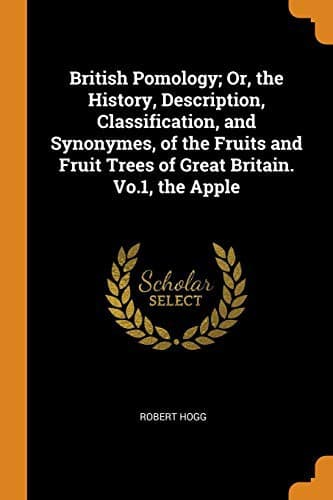
British Pomology: Or, the History, Description, Classification, and Synonymes, of the Fruits and Fruit Trees of Great BritainHogg, Robert
History
British Pomology: Or, the History, Description, Classification, and Synonymes, of the Fruits and Fruit Trees of Great Britain
Hogg, Robert
Apples
The tree is hardy, vigorous, a most abundant bearer, and even in
seasons when other varieties fail, this is almost safe to ensure a
plentiful crop. It is extensively cultivated in Norfolk, and deserves
to be more generally known in other districts of the country.
20. BEACHAMWELL.--Hort.
IDENTIFICATION--Lind. Guide, 35. Hort. Soc. Cat. ed. 3, n. 13.
SYNONYMES.--Beachamwell Seedling, _Hort. Soc. Cat._ ed. 1, 42.
Motteux’s Seedling, _Acc. Hort. Soc. Cat._
FIGURES.--Pom. Mag. t. 82. Ron. Pyr. Mal. pl. xxvii. f. 6.
Fruit, small, about two inches wide, and the same in height; ovate,
handsomely and regularly formed. Skin, greenish yellow, covered with
patches and dots of russet, particularly round the eye. Eye, small and
open, set in a shallow, narrow, and even basin. Stalk, about half an
inch long, almost embedded in a round cavity. Flesh, yellowish white,
tender, crisp, and very juicy, with a rich, brisk, and sugary flavor.
A rich and deliciously flavored dessert apple, of the highest
excellence; in use from December to March.
The tree is perfectly hardy, a healthy and vigorous grower, but does
not attain a large size; it is an excellent bearer.
This variety was raised by John Motteux, Esq., of Beachamwell, in
Norfolk, where, according to Mr. George Lindley, the original tree
still existed in 1831. It is not very generally cultivated, but ought
to form one even in the smallest collections.
21. BEAUTY OF KENT.--Fors.
IDENTIFICATION.--Fors. Treat. 93. Lind. Guide, 27. Hort. Soc. Cat. ed.
3, n. 37. Down. Fr. Amer. 81.
SYNONYME.--Kentish Pippin, of some, _Acc. Hort. Soc. Cat._
FIGURES.--Brook. Pom. Brit. pl. xc. f. 6. Ron. Pyr. Mal. pl. xv. f. 1.
[Illustration]
Fruit, large; roundish-ovate, broad and flattened at the base, and
narrowing towards the apex, where it is terminated by several prominent
angles. Skin, deep yellow slightly tinged with green, and marked with
faint patches of red, on the shaded side; but entirely covered with
deep red, except where there are a few patches of deep yellow, on the
side next the sun. Eye, small and closed, with short segments, and set
in a narrow and angular basin. Stalk, short, inserted in a wide and
deep cavity, which, with the base, is entirely covered with rough brown
russet. Flesh, yellowish, tender, and juicy, with a pleasant sub-acid
flavor.
A valuable and now well-known culinary apple, in use from October
to February. When well grown the Beauty of Kent is perhaps the most
magnificent apple in cultivation. Its great size, the beauty of its
coloring, the tenderness of the flesh, and profusion of delicate
sub-acid juice, constitute it one of our most popular winter apples,
for culinary purposes, and one of the most desirable and useful, either
for a small garden, or for more extended cultivation.
Public-domain text, read in full here on John Shaqi.
Reviews
Reviews
No reviews yet
Be the first to share your thoughts on this work.
Join the Discussion
Join the discussion
Sign in to leave a comment or review.
Sign InorCreate an account