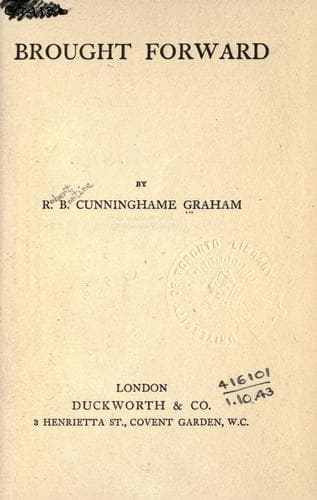
Brought ForwardCunninghame Graham, R. B. (Robert Bontine)
History
Brought Forward
Cunninghame Graham, R. B. (Robert Bontine)
Fiction; Short stories
My host went on: “Some time ago I walked up to the little moor that
overlooks the Clyde, from which you see ships far off lying at the Tail
of the Bank, the smoke of Greenock and Port Glasgow, the estuary itself,
though miles away, looking like a sheet of frosted silver or dark-grey
steel, according to the season, and in the distance the range of hills
called Argyle’s Bowling Green, with the deep gap that marks the entrance
to the Holy Loch. Autumn had just begun to tinge the trees, birches were
golden, and rowans red, the bents were brown and dry. A few bog
asphodels still showed amongst the heather, and bilberries, dark as black
currants, grew here and there amongst the carpet of green sphagnum and
the stag’s-head moss. The heather was all rusty brown, but still there
was, as it were, a recollection of the summer in the air. Just the kind
of day you feel inclined to sit down on the lee side of a dry-stone dyke,
and smoke and look at some familiar self-sown birch that marks the flight
of time, as you remember that it was but a year or two ago that it had
first shot up above the grass.
“I remember two or three plants of tall hemp-agrimony still had their
flower heads withered on the stalk, giving them a look of wearing wigs,
and clumps of ragwort still had a few bees buzzing about them, rather
faintly, with a belated air. I saw all this—not that I am a botanist,
for you know I can hardly tell the difference between the Cruciferæ and
the Umbelliferæ, but because when you live in the country some of the
common plants seem to obtrude themselves upon you, and you have got to
notice them in spite of you. So I walked on till I came to a wrecked
plantation of spruce and of Scotch fir. A hurricane had struck it,
turning it over almost in rows, as it was planted. The trees had
withered in most cases, and in the open spaces round their upturned roots
hundreds of rabbits burrowed, and had marked the adjoining field with
little paths, just like the lines outside a railway-station.
“I saw all this, not because I looked at it, for if you look with the
idea of seeing everything, commonly everything escapes you, but because
the lovely afternoon induced a feeling of well-being and contentment, and
everything seemed to fall into its right proportion, so that you saw
first the harmonious whole, and then the salient points most worth the
looking at.
Public-domain text, read in full here on John Shaqi.
Reviews
Reviews
No reviews yet
Be the first to share your thoughts on this work.
Join the Discussion
Join the discussion
Sign in to leave a comment or review.
Sign InorCreate an account