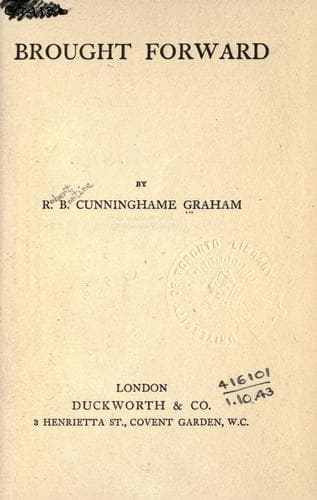
Brought ForwardCunninghame Graham, R. B. (Robert Bontine)
History
Brought Forward
Cunninghame Graham, R. B. (Robert Bontine)
Fiction; Short stories
In one of them—I remember it just as if now it was before my eyes—an
Indian chief, surrounded by his friends, was setting free his favourite
horse upon the prairies, either before his death or in reward of faithful
services. The little group of men cut in the stone, most probably with
an obsidian arrow-head, was life-like, though drawn without perspective,
which gave those figures of a vanished race an air of standing in the
clouds.
The chief stood with his bridle in his hand, his feather war-bonnet upon
his head, naked except the breech-clout. His bow was slung across his
shoulders and his quiver hung below his arm, and with the other hand he
kept the sun off from his face as he gazed upon his horse. All kinds of
hunting scenes were there displayed, and others, such as the burial of a
chief, a dance, and other ceremonials, no doubt as dear to those who drew
them as are the rites in a cathedral to other faithful. The flat rock
bore one more inscription, stating that Eusebio Leal passed by bearing
despatches, and the date, June the fifteenth, of the year 1687. But to
return again to the lone wickey-up.
We all sat looking at it: Eustaquio Gomez, Polibio Medina, Exaltacion
Garcia, the Texan, two Pueblo Indians, and I who write these lines.
Somehow it had an eerie look about it, standing so desolate, out in those
flowery wilds.
Inside it lay the body of a man, with the skin dry as parchment, and his
arms beside him, a Winchester, a bow and arrows, and a lance. Eustaquio,
taking up an arrow, after looking at it, said that the dead man was an
Apache of the Mescalero band, and then, looking upon the ground and
pointing out some marks, said, “He had let loose his horse before he
died, just as the chief did in the picture-writing.”
That was his epitaph, for how death overtook him none of us could
conjecture; but I liked the manner of his going off the stage.
’Tis meet and fitting to set free the horse or pen before death overtakes
you, or before the gentle public turns its thumbs down and yells, “Away
with him.”
Charles Lamb, when some one asked him something of his works, answered
that they were to be found in the South Sea House, and that they numbered
forty volumes, for he had laboured many years there, making his bricks
with the least possible modicum of straw,—just like the rest of us.
Mine, if you ask me, are to be found but in the trails I left in all the
years I galloped both on the prairies and the pampas of America.
Hold it not up to me for egotism, O gentle reader, for I would have you
know that hardly any of the horses that I rode had shoes on them, and
thus the tracks are faint.
_Vale_.
R. B. CUNNINGHAME GRAHAM.
CONTENTS
Public-domain text, read in full here on John Shaqi.
Reviews
Reviews
No reviews yet
Be the first to share your thoughts on this work.
Join the Discussion
Join the discussion
Sign in to leave a comment or review.
Sign InorCreate an account