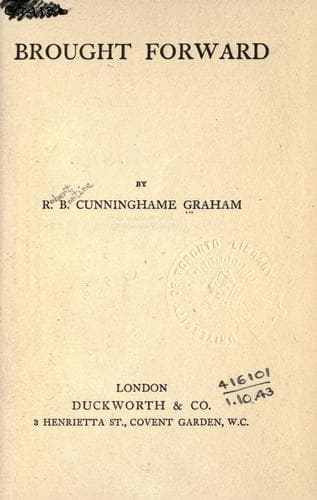
Brought ForwardCunninghame Graham, R. B. (Robert Bontine)
History
Brought Forward
Cunninghame Graham, R. B. (Robert Bontine)
Fiction; Short stories
A cheer at the far corner of the square showed that the ranks were
formed. A policeman on a scraggy horse, with a great rusty sabre banging
at its side, rode slowly down the streets to clear the way, and once
again the parti-coloured band passed by, playing the Garibaldian hymn.
Rank upon rank of men tramped after it, their friends running beside them
for a last embrace, and women rushing up with children for a farewell
kiss. Their merry faces set with determination, and their shoulders well
thrown back, three or four hundred men briskly stepped along, trying to
imitate the way the Bersaglieri march in Italy. A shout went up of “Long
live the Reservists,” as a contingent, drawn from every class of the
Italian colony, passed along the street. Dock-labourers and pale-faced
clerks in well-cut clothes and unsubstantial boots walked side by side.
Men burnt the colour of a brick by working at the harvest rubbed
shoulders with Sicilian emigrants landed a month or two ago, but who now
were going off to fight, as poor as when they left their native land, and
dressed in the same clothes. Neapolitans, gesticulating as they marched,
and putting out their tongues at the Brazilian negroes, chattered and
joked. To them life was a farce, no matter that the setting of the stage
on which they moved was narrow, the fare hard, and the remuneration
small. If things were adverse they still laughed on, and if the world
was kind they jeered at it and at themselves, disarming both the slings
of fortune and her more dangerous smiles with a grimace.
As they marched on, they now and then sketched out in pantomime the fate
of any German who might fall into their hands, so vividly that shouts of
laughter greeted them, which they acknowledged by putting out their
tongues. Square-shouldered Liguresi succeeded them, with Lombards,
Sicilians, and men of the strange negroid-looking race from the
Basilicata, almost as dark-skinned as the Brazilian loungers at the
corners of the streets.
They all passed on, laughing, and quite oblivious of what was in store
for most of them—laughing and smoking, and, for the first time in their
lives, the centre of a show. After them came another band; but this time
of Italians, well-dressed, and playing on well-cared-for instruments.
Behind them walked a little group of men, on whose appearance a hush fell
on the crowd. Two of them wore uniforms, and between them, supported by
silk handkerchiefs wrapped round his arms, there walked a man who was
welcomed with a scream of joy. Frail, and with trembling footsteps,
dressed in a faded old red shirt and knotted handkerchief, his parchment
cheeks lit up with a faint flush as the Veteran of Marsala passed like a
phantom of a glorious past. With him appeared to march the rest of his
companions who set sail from Genoa to call into existence that Italy for
which the young men all around him were prepared to sacrifice their
lives.
Public-domain text, read in full here on John Shaqi.
Reviews
Reviews
No reviews yet
Be the first to share your thoughts on this work.
Join the Discussion
Join the discussion
Sign in to leave a comment or review.
Sign InorCreate an account