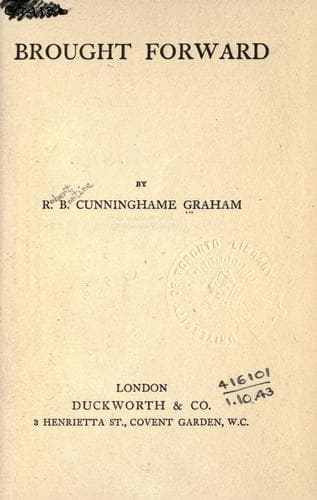
Brought ForwardCunninghame Graham, R. B. (Robert Bontine)
History
Brought Forward
Cunninghame Graham, R. B. (Robert Bontine)
Fiction; Short stories
By the air they wore of chastened pleasure, all those who knew them saw
that they were intent upon a funeral. To serious-minded men such as are
they, for all their quickness, nothing is so soul-filling, for it is of
the nature of a fact that no one can deny. A wedding has its
possibilities, for it may lead to children, or divorce, but funerals are
in another category. At them the Scottish people is at its best, for
never more than then does the deep underlying tenderness peep through the
hardness of the rind. On foot and in the tramways, but most especially
on foot, converged long lines of men and women, though fewer women, for
the national prejudice that in years gone by thought it not decent for a
wife to follow to the grave her husband’s coffin, still holds a little in
the north. Yet there was something in the crowd that showed it was to
attend no common funeral, that they were “stepping west.” No one wore
black, except a minister or two, who looked a little like the belated
rook you sometimes see amongst a flock of seagulls, in that vast ocean of
grey tweed.
They tramped along, the whistling north-east wind pinching their
features, making their eyes run, and as they went, almost unconsciously
they fell into procession, for beyond the tramway line, a country lane
that had not quite put on the graces of a street, though straggling
houses were dotted here and there along it, received the crowd and
marshalled it, as it were mechanically, without volition of its own.
Kept in between the walls, and blocked in front by the hearse and long
procession of the mourning-coaches, the people slowly surged along. The
greater portion of the crowd were townsmen, but there were miners washed
and in their Sunday best. Their faces showed the blue marks of healed-up
scars into which coal dust or gunpowder had become tattooed, scars gained
in the battle of their lives down in the pits, remembrances of falls of
rock or of occasions when the mine had “fired upon them.”
Many had known Keir Hardie in his youth, had “wrocht wi’ him out-by,” at
Blantyre, at Hamilton, in Ayrshire, and all of them had heard him speak a
hundred times. Even to those who had not heard him, his name was as a
household word. Miners predominated, but men of every trade were there.
Many were members of that black-coated proletariat, whose narrow
circumstances and daily struggle for appearances make their life harder
to them than is the life of any working man before he has had to dye his
hair. Women tramped, too, for the dead leader had been a champion of
their sex. They all respected him, loving him with that
half-contemptuous gratitude that women often show to men who make the
“woman question” the object of their lives.
Public-domain text, read in full here on John Shaqi.
Reviews
Reviews
No reviews yet
Be the first to share your thoughts on this work.
Join the Discussion
Join the discussion
Sign in to leave a comment or review.
Sign InorCreate an account