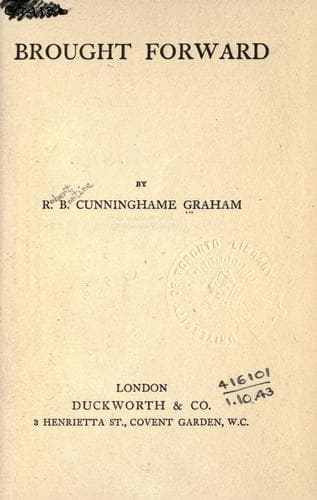
Brought ForwardCunninghame Graham, R. B. (Robert Bontine)
History
Brought Forward
Cunninghame Graham, R. B. (Robert Bontine)
Fiction; Short stories
“There is the house,” he said, “just at the bottom of the hollow, only
five squares away,” and as we saw the flicker of the lights, he struck
his palm upon his mouth after the Indian fashion, and raised a piercing
cry. Easing his hand, he drove his spurs into his horse, who started
with a bound into full speed, and as he galloped down the hill we
followed him, all yelling furiously.
Just at the hitching-post we drew up with a jerk, our horses snorting as
they edged off sideways from the black shadow that it cast upon the
ground. Horses stood about everywhere, some tied and others hobbled, and
from the house there came the strains of an accordion and the tinkling of
guitars.
Asking permission to dismount, we hailed the owner of the house, a tall,
old Gaucho, Frutos Barragán, as he stood waiting by the door, holding a
maté in his hand. He bade us welcome, telling us to tie our horses up,
not too far out of sight, for, as he said, “It is not good to give
facilities to rogues, if they should chance to be about.”
In the low, straw-thatched rancho, with its eaves blackened by the smoke,
three or four iron bowls, filled with mare’s fat, and with a cotton wick
that needed constant trimming, stuck upon iron cattle-brands, were
burning fitfully.
They cast deep shadows in the corners of the room, and when they
flickered up occasionally the light fell on the dark and sun-tanned faces
of the tall, wiry Gauchos and the light cotton dresses of the women as
they sat with their chairs tilted up against the wall. Some thick-set
Basques, an Englishman or two in riding breeches, and one or two Italians
made up the company. The floor was earth, stamped hard till it shone
like cement, and as the Gauchos walked upon it, their heavy spurs clinked
with a noise like fetters as they trailed them on the ground.
An old, blind Paraguayan played on the guitar, and a huge negro
accompanied him on an accordion. Their united efforts produced a music
which certainly was vigorous enough, and now and then, one or the other
of them broke into a song, high-pitched and melancholy, which, if you
listened to it long enough, forced you to try to imitate its wailing
melody and its strange intervals.
Fumes of tobacco and rum hung in the air, and of a strong and heady wine
from Catalonia, much favoured by the ladies, which they drank from a
tumbler, passing it to one another, after the fashion of a grace-cup at a
City dinner, with great gravity. At last the singing ceased, and the
orchestra struck up a Tango, slow, marked, and rhythmical.
Public-domain text, read in full here on John Shaqi.
Reviews
Reviews
No reviews yet
Be the first to share your thoughts on this work.
Join the Discussion
Join the discussion
Sign in to leave a comment or review.
Sign InorCreate an account