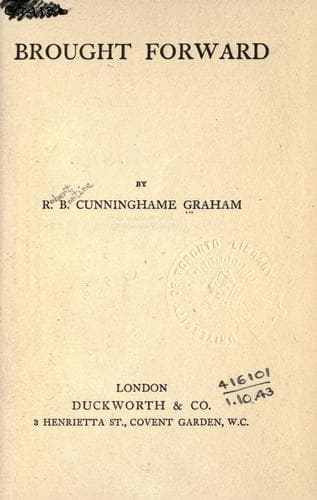
Brought ForwardCunninghame Graham, R. B. (Robert Bontine)
History
Brought Forward
Cunninghame Graham, R. B. (Robert Bontine)
Fiction; Short stories
The reader then would pause and, looking round the shop, wait for the
answer that he was sure would not be long in coming from amongst such a
thrawn lot of commentators. Usually one or other of his mates would fold
his paper up, or perhaps point with an oil-stained finger to an article,
and with the head-break in the voice, characteristic of the Scot about to
plunge into an argument, ejaculate: “Bonar Law, ou aye, I kent him when
he was leader of the South Side Parliament. He always was a dreary body,
sort o’ dreich like; no that I’m saying the man is pairfectly illiterate,
as some are on his side o’ the Hoose there in Westminister. I read his
speech—the body is na blate, sort o’ quick at figures, but does na take
the pains to verify. Verification is the soul of mathematics. Bonar
Law, eh! Did ye see how Maister Asquith trippit him handily in his
tabulated figures on the jute business under Free Trade, showing that all
he had advanced about protective tariffs and the drawback system was fair
redeeklous . . . as well as several errors in the total sum?”
Then others would cut in and words be bandied to and fro, impugning the
good faith and honour of every section of the House of Commons, who, by
the showing of their own speeches, were held to be dishonourable rogues
aiming at power and place, without a thought for anything but their own
ends.
This charitable view of men and of affairs did not prevent any of the
disputants from firing up if his own party was impugned; for in their
heart of hearts the general denunciation was but a covert from which to
attack the other side.
In such an ambient the war was sure to be discussed; some held the German
Emperor was mad—“a daft-like thing to challenge the whole world, ye see;
maist inconsiderate, and shows that the man’s intellect is no weel
balanced . . . philosophy is whiles sort of unsettlin’ . . . the felly’s
mad, ye ken.”
Others saw method in his madness, and alleged that it was envy, “naething
but sheer envy that had brought on this tramplin’ upon natural rights,
but for all that he may be thought to get his own again, with they
indemnities.”
Those who had studied economics “were of opinion that his reasoning was
wrong, built on false premises, for there can never be a royal road to
wealth. Labour, ye see, is the sole creative element of riches.” At
once a Tory would rejoin, “And brains. Man, what an awfu’ thing to leave
out brains. Think of the marvellous creations of the human genius.” The
first would answer with, “I saw ye coming, man. I’ll no deny that brains
have their due place in the economic state; but build me one of your
Zeppelins and stick it in the middle of George Square without a crew to
manage it, and how far will it fly? I do not say that brains did not
devise it; but, after all, labour had to carry out the first design.”
This was a subject that opened up enormous vistas for discussion, and for
a time kept them from talking of the war.
Public-domain text, read in full here on John Shaqi.
Reviews
Reviews
No reviews yet
Be the first to share your thoughts on this work.
Join the Discussion
Join the discussion
Sign in to leave a comment or review.
Sign InorCreate an account