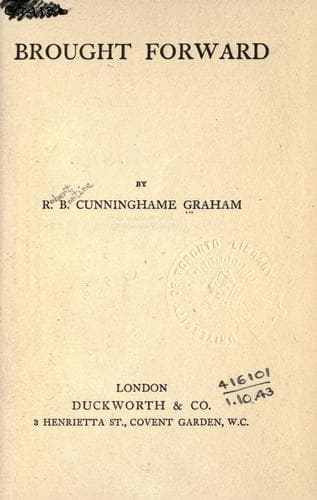
Brought ForwardCunninghame Graham, R. B. (Robert Bontine)
History
Brought Forward
Cunninghame Graham, R. B. (Robert Bontine)
Fiction; Short stories
The park-like English landscape, with its hedgerow trees and its lush
fields, that does not look like as if it really were the country, but
seems a series of pleasure-grounds cut off into convenient squares, was
at its time of greatest beauty and its greatest artificiality. Cows
swollen with grass till they looked like balloons lay in the fields and
chewed the cud. Geese cackled as they strayed upon the common, just as
they appear to cackle in a thousand water-colours. The hum of bees was
in the limes. Dragon-flies hawked swiftly over the oily waters of the
two slow-flowing rivers that made the farm almost an island in a suburban
Mesopotamia, scarce twenty miles away from Charing Cross. An air of
peace and of contentment, of long well-being and security, was evident in
everything. Trees flourished, though stag-headed, under which the
Roundhead troopers may have camped, or at the least, veterans from
Marlborough’s wars might have sat underneath their shade, and smoked as
they retold their fights.
A one-armed signboard, weathered, and with the lettering almost
illegible, pointed out the bridle-path to Ditchley, now little used,
except by lovers on a Sunday afternoon, but where the feet of horses for
generations in the past had trampled it, still showing clearly as it
wound through the fields.
In the standing corn the horses yoked to the reaping machine stood
resting, now and again shaking the tassels on their little netted
ear-covers. They, too, came of a breed long used to peace and plenty,
good food and treatment, and short hours of work. The kindly landscape
and the settled life of centuries had formed the kind of man of which the
farmer was a prototype,—slow-footed and slow-tongued, and with his mind
as bowed as were his shoulders with hard work, by the continual pressure
of the hierarchy of wealth and station, that had left him as much
adscript to them as any of his ancestors had been bound to their glebes.
He held the _Daily Mail_, his gospel and his _vade mecum_, crumpled in
his hand as if he feared to open it again to read more details of the
war. A simple soul, most likely just as oppressive to his labourers as
his superiors had always showed themselves to him, he could not bear to
read of violence, as all the tyranny that he had bent under had been
imposed so subtly that he could never see more than the shadow of the
hand that had oppressed him.
It pained him, above all things, to read about the wounded and dead
horses lying in the corn, especially as he had “’eard the ’arvest over
there in Belgium was going to be good.” The whirr of the machines
reaping the wheatfield sounded like the hum of some gigantic insect, and
as the binder ranged the sheaves in rows it seemed as if the golden age
had come upon the earth again, bringing with it peace and plenty, with
perhaps slightly stouter nymphs than those who once followed the
sickle-men in Arcady.
Public-domain text, read in full here on John Shaqi.
Reviews
Reviews
No reviews yet
Be the first to share your thoughts on this work.
Join the Discussion
Join the discussion
Sign in to leave a comment or review.
Sign InorCreate an account