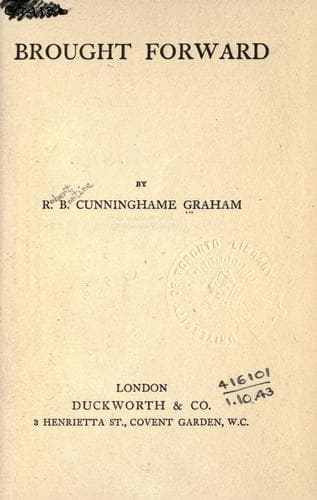
Brought ForwardCunninghame Graham, R. B. (Robert Bontine)
History
Brought Forward
Cunninghame Graham, R. B. (Robert Bontine)
Fiction; Short stories
So they continued spearing the god-like beasts, regardless of the heat
and that their horses were in poor condition owing to their long march.
The horse of one Palacios Rubio, a relation of Cortes, fell dead,
overcome with the great heat; the grease inside him melted, Villagutierre
says. The black horse that was ridden by Cortes also was very ill,
although he did not die—though it perhaps had been better that he should
have died, for Villagutierre thinks “far less harm would have been done
than happened afterwards, as will be seen by those who read the tale.”
After the hunting all was over, the line of march led over stony hills,
and through a pass that Villagutierre calls “el Paso del Alabastro,” and
Diaz “La Sierra de los Pedernales” (flints). Here the horse that had
been ill, staked itself in a forefoot, and this, as Villagutierre says,
was the real reason that Cortes left him behind. He adds, “It does not
matter either way, whether he was left because his grease was melted with
the sun, or that his foot was staked.” This, of course, is true, and
anyhow the horse was reserved for a greater destiny than ever fell to any
of his race.
Cortes, in his fifth letter to the Emperor Charles V., says simply, “I
was obliged to leave my black horse (_mi caballo morzillo_) with a
splinter in his foot.” He takes no notice of the melting of the grease.
“The Chief promised to take care of him, but I do not know that he will
succeed or what he will do with him.”
He told the Chief that he would send to fetch the horse, for he was very
fond of him, and prized him very much. The Chief, no doubt, received the
strange and terrible animal with due respect, and Cortes went on upon his
way. That is all that Cortes says about the matter, and the mist of
history closed upon him and on his horse. Cortes died, worn-out and
broken-hearted, at the white little town of Castilleja de la Cuesta, not
far from Seville; but El Morzillo had a greater destiny in store. This
happened in the year 1525, and nothing more was heard of either the
Maçotecas or the horse, after that passage in the fifth letter of Cortes,
till 1697. In that year the Franciscans set out upon the gospel trail to
convert the Indians of Itza, attached to the expedition that Ursua led,
for the interior of Yucatan had never been subdued. They reached Itza,
having come down the River Tipu in canoes.
This river, Villagutierre informs us, is as large as any river in all
Spain. Moreover, it is endowed with certain properties, its water being
good and clear, so that in some respects it is superior to the water even
of the Tagus. It is separated into one hundred and ninety channels
(neither more nor less), and every one of these has its right Indian
name, that every Indian knows. Upon its banks grows much sarsaparilla,
and in its sand is gold.
Public-domain text, read in full here on John Shaqi.
Reviews
Reviews
No reviews yet
Be the first to share your thoughts on this work.
Join the Discussion
Join the discussion
Sign in to leave a comment or review.
Sign InorCreate an account