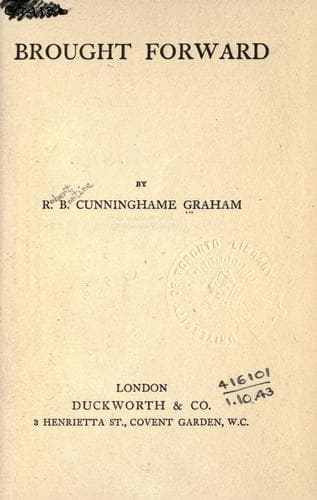
Brought ForwardCunninghame Graham, R. B. (Robert Bontine)
History
Brought Forward
Cunninghame Graham, R. B. (Robert Bontine)
Fiction; Short stories
“Sweaters and sweated, the poor, the rich, men, women, children, all
mankind, suffer from want of Love. I am not here to say that natural
laws will ever cease to operate, or that there will not be great
inequalities, if not of fortune, yet of endowments, to the end of Time.
What the Great Power who sent us here intended, only He can tell. One
thing He placed within the grasp of every one, capacity to love. Think,
friends, what England might become under the reign of universal love.
The murky fumes that now defile the landscape, the manufactories in which
our thousands toil for others, the rivers vile with refuse, the knotted
bodies and the faces scarcely human in their abject struggle for their
daily bread, would disappear. Bradford and Halifax and Leeds would once
again be fair and clean. The ferns would grow once more in Shipley Glen,
and in the valleys about Sheffield the scissor-grinders would ply their
trade upon streams bright and sparkling, as they were of yore. In
Halifax, the Roman road, now black with coal-dust and with mud, would
shine as well-defined as it does where now and then it crops out from the
ling upon the moors, just as the Romans left it polished by their
caligulæ. Why, do you ask me? Because all sordid motives would be gone,
and of their superfluity the rich would give to those less blessed by
Providence. The poor would grudge no one the gifts of fortune, and thus
the need for grinding toil would disappear, as the struggle and the
strain for daily bread would fade into the past.
“Picture to yourselves, my friends, an England once more green and merry,
with the air fresh and not polluted by the smoke of foetid towns.
“’Tis pleasant, friends, on a spring morning to hear the village bells
calling to church, even although they do not call you to attend. It
heals the soul to see the honeysuckle and the eglantine and smell the
new-mown hay. . . .
“Then comes a chill when on your vision rises the England of the
manufacturing town, dark, dreary, and befouled with smoke. How different
it might be in the perpetual May morning I have sketched for you.
“Love suffereth all things, endureth all things, createth all things. . . .”
He paused, and, looking round, saw he was all alone. The boys had stolen
away, and the last workman’s sturdy back could be just seen as it was
vanishing towards the public-house.
The speaker sighed, and wiped the perspiration from his forehead with a
soiled handkerchief.
Then, picking up his hat and his umbrella, a far-off look came into his
blue eyes as he walked homewards almost jauntily, conscious that the
inner fire had got the better of the fleshly tenement, and that his work
was done.
XIII
EL MASGAD
Public-domain text, read in full here on John Shaqi.
Reviews
Reviews
No reviews yet
Be the first to share your thoughts on this work.
Join the Discussion
Join the discussion
Sign in to leave a comment or review.
Sign InorCreate an account