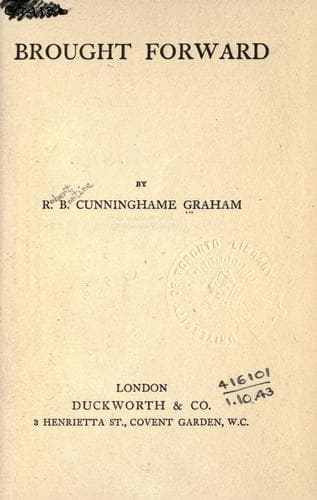
Brought ForwardCunninghame Graham, R. B. (Robert Bontine)
History
Brought Forward
Cunninghame Graham, R. B. (Robert Bontine)
Fiction; Short stories
The tents lay in the moonlight like gigantic mushrooms; the rows of
bottles cut in blue cloth with which the Arabs ornament them stood out
upon the canvas as if in high relief. The first light dew was falling,
frosting the canvas as a piece of ice condenses air upon a glass. In a
long line before the tents stood the pack animals munching their corn
placed on a cloth upon the ground.
A dark-grey horse, still with his saddle on for fear of the night air,
was tied near to the door of the chief tent, well in his owner’s eye.
Now and again he pawed the ground, looked up, and neighed, straining upon
the hobbles that confined his feet fast to the picket line.
On a camp chair his owner sat and smoked, and now and then half got up
from his seat when the horse plunged or any of the mules stepped on their
shackles and nearly fell upon the ground.
As the Sherif approached he rose to welcome him, listening to all the
reiterated compliments and inquiries that no self-respecting Arab ever
omits when he may chance to meet a friend.
A good address, like mercy, is twice blest, both in the giver and in the
recipient of it; but chiefly it is beneficial to the giver, for in
addition to the pleasure that he gives, he earns his own respect. Well
did both understand this aspect of the question, and so the compliments
stretched out into perspectives quite unknown in Europe, until the host,
taking his visitor by the hand, led him inside the tent. “Ambassador,”
said the Sherif, although he knew his friend was but a Consul, “my heart
yearned towards thee, so I have come to talk with thee of many things,
because I know that thou art wise, not only in the learning of thy
people, but in that of our own.”
The Consul, not knowing what the real import of the visit might portend,
so to speak felt his adversary’s blade, telling him he was welcome, and
that at all times his tent and house were at the disposition of his
friend. Clapping his hands he called for tea, and when it came, the
little flowered and gold-rimmed glasses, set neatly in a row, the red tin
box with two compartments, one for the tea and one for the blocks of
sugar, the whole surrounding the small dome-shaped pewter teapot, all
placed in order on the heavy copper tray, he waved the equipage towards
the Sherif, tacitly recognising his superiority in the art of tea-making.
Seated beside each other on a mattress they drank the sacramental three
cups of tea, and then, after the Consul had lit his cigarette, the Sherif
having refused one with a gesture of his hand and a half-murmured
“Haram”—that is, “It is prohibited”—they then began to talk.
Public-domain text, read in full here on John Shaqi.
Reviews
Reviews
No reviews yet
Be the first to share your thoughts on this work.
Join the Discussion
Join the discussion
Sign in to leave a comment or review.
Sign InorCreate an account