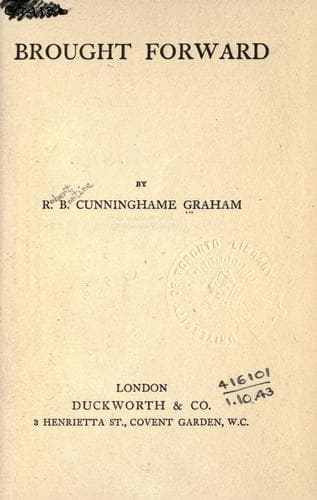
Brought ForwardCunninghame Graham, R. B. (Robert Bontine)
History
Brought Forward
Cunninghame Graham, R. B. (Robert Bontine)
Fiction; Short stories
Upon three sides ran the low, continuous line of houses, like a “row” in
a Scotch mining village or a phalanstery designed by Prudhon or St. Simon
in their treatises; but by the grace of a kind providence never carried
out, either in bricks or stone.
Each dwelling-place was of the same design and size as all the rest.
Rough tiles made in the Jesuit times, but now weathered and broken,
showing the rafters tied with raw hide in many places, formed the long
roof, that looked a little like the pent-house of a tennis court.
A deep verandah ran in front, stretching from one end to the other of the
square, supported on great balks of wood, which, after more than two
hundred years and the assaults of weather and the all-devouring ants,
still showed the adze marks where they had been dressed. The timber was
so hard that you could scarcely drive a nail into it, despite the flight
of time since it was first set up. Rings fixed about six feet from the
ground were screwed into the pillars of the verandah, before every door,
to fasten horses to, exactly as they are in an old Spanish town.
Against the wall of almost every house, just by the door, was set a chair
or two of heavy wood, with the seat formed by strips of hide, on which
the hair had formerly been left, but long ago rubbed off by use, or eaten
by the ants.
The owner of the house sat with the back of the strong chair tilted
against the wall, dressed in a loose and pleated shirt, with a high
turned-down collar open at the throat, and spotless white duck trousers,
that looked the whiter by their contrast with his brown, naked feet.
His home-made palm-tree hat was placed upon the ground beside him, and
his cloak of coarse red baize was thrown back from his shoulders, as he
sat smoking a cigarette rolled in a maize leaf, for in the Jesuit
capillas only women smoked cigars.
At every angle of the square a sandy trail led out, either to the river
or the woods, the little patches planted with mandioca, or to the maze of
paths that, like the points outside a junction, eventually joined in one
main trail, that ran from Itapua on the Paraná, up to Asuncion.
The church, built of wood cut in the neighbouring forest, had two tall
towers, and followed in its plan the pattern of all the churches in the
New World built by the Jesuits, from California down to the smallest
mission in the south. It filled the fourth side of the square, and on
each side of it there rose two feathery palms, known as the tallest in
the Missions, which served as landmarks for travellers coming to the
place, if they had missed their road. So large and well-proportioned was
the church, it seemed impossible that it had been constructed solely by
the Indians themselves, under the direction of the missionaries.
Public-domain text, read in full here on John Shaqi.
Reviews
Reviews
No reviews yet
Be the first to share your thoughts on this work.
Join the Discussion
Join the discussion
Sign in to leave a comment or review.
Sign InorCreate an account