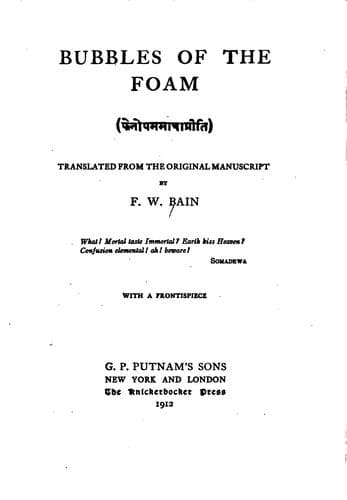
Such then is the theme of _Bubbles of the Foam_: a little love-story,
whose title, like that of all her elder sisters, has in the original a
double application, by reason of the ambiguity of the last word, to
Love, and to the Moon. We might also render it, _A Heavenly Bubble_, or,
_Love is a Bubble_, or _Nothing but a Bubble_, or _A Bubble of the
World_,[3] thinking either of Love or the Moon. For the Moon, like the
goddess of Love, rose originally from the sea: and they retain traces of
their origin, both in their essence and their appearance. For what is
more like a great Foam-Bubble than the Moon? and what is more like the
delusion of love than a bubble of the foam, so beautiful in its play of
colour, while it endures: so evanescent, so hollow, leaving behind it
when it bursts and disappears nothing but a memory, and a bitter taste
of brine? And as love is but a bubble, so are all its victims merely
bubbles of a bubble: for this also is mirage.
[Footnote 3: I was sorely tempted to give it the title of _Mere Foam_:
which, if the reader would kindly understand _mere_ in its German, its
Russian, its Latin, and its ordinary English sense, would be an exact
translation. But it has an unfortunate suggestion (_meerschaum_) which
made it impossible.]
Mirage! mirage! That is the keynote of the old melancholy Indian music;
the bass, whose undertone accompanies, with a kind of monotonous
solemnity, all the treble variations in the minor key. The world is
unreal, a delusion and a snare; sense is deception, happiness a dream;
nothing has true being, is absolute, but virtue, the sole reality; that
which most emphatically IS,[4] attainable only through knowledge, the
great illuminator, the awakener to the perception of the truth. We move,
like marionettes, pulled by the strings of our forgotten antenatal
deeds, in a magic cage, or Net, of false and hypocritical momentary
seemings: and bitter disappointment is the inevitable doom of every
soul, that with passion for its guide in the gloom, thinks to find in
the shadows that surround it any substance, any solid satisfaction; any
permanent in the mutable; any rest in the ceaseless revolution; any
peace which the world cannot give. Who would have peace, must turn his
back upon the world; it lies the Other Way. Three are the Ways: the Way
of the World, the Way of Woman, the Way of Emancipation.
[Footnote 4: _Sat._ The thesis of Socrates, that virtue is knowledge:
probably borrowed, by steps that we cannot trace, through Pythagoras or
"Orpheus" from the East.]
Public-domain text, read in full here on John Shaqi.
Reviews
Reviews
No reviews yet
Be the first to share your thoughts on this work.
Join the Discussion
Join the discussion
Sign in to leave a comment or review.
Sign InorCreate an account