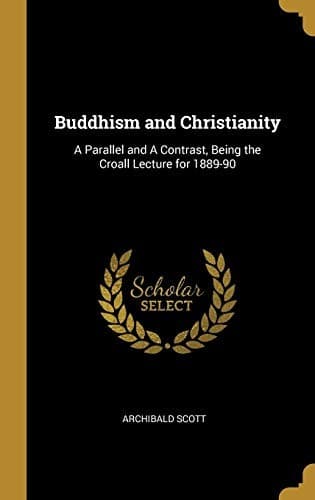
Buddhism and Christianity: A Parallel and a ContrastScott, Archibald
Religion
Buddhism and Christianity: A Parallel and a Contrast
Scott, Archibald
Buddhism -- Relations -- Christianity; Christianity and other religions -- Buddhism
Now while the supernatural only rarely meets us in the most ancient
Buddhist productions, where we would naturally have expected it to have
predominated, it meets us in the very earliest writings of Christianity,
where we would not have expected it at all. Christ to His first
disciples and apostles was a miraculous being. The claim formulated in
St. John’s Gospel, which is probably the latest book in the New
Testament, is that advanced for Christ by St. Paul in his earliest
extant letter to the churches. The Christ of St. John is not a new
Person, but the same Divine Being of whom St. Paul says, “He being in
the form of God” was “found on earth in fashion as a man.” He may have
been all wrong as to the ground of his belief; he may have been an
epileptic, a visionary, a man subject to trances, whose intense
spiritual affinities disqualified him from judging calmly of matters of
history; but there is no mistake as to his own belief and that of the
other evangelists and writers of the New Testament. The teaching of St.
Paul and St. John concerning Christ is set forth in St. Matthew with a
clearness which no language can improve upon.[165] St. Mark dwells
primarily upon the humanity of Jesus, a most important fact, presenting
a historic basis without which Christian truth would have been little
more than a mystic speculation; but even in St. Mark that humanity is
not described as unfolding under conditions which are merely
normal.[166] The life to which he testifies is not just that of Jesus of
Nazareth, but of the Christ of God, who speaks with more than human
authority. The development which is traceable in the theology of the
Epistles is the expansion of the significance of the events recorded in
the Gospels. The latest writings may more fully interpret the teaching
of the earlier ones, but in them we find no other Gospels, but only
anathemas pronounced on those who pretend to have them. In them a larger
domain is seen expanding beneath our gaze, but it is visible only in the
light of the central figure that meets us in the first. Plainly,
therefore, while the earliest Buddhist witnesses account for their
master and his teaching in the ordinary ways, and while their successors
much later on in their attempts to embellish his portrait have produced
quite a different person from the man of whom they first testified, the
very earliest Christian writers could not account for Christ in any
other way than by regarding Him as a supernatural being, who did not
come into the world and did not leave it in the way of all other men. It
is possible that they may all have been deluded, but if so, they vouched
for their sincerity by their martyrdoms. The delusion, moreover, was at
least universally and most consistently maintained, and it is the first
instance in the history of mankind where a delusion has produced
intellectual activity and expansion so wonderful as to have changed the
current of history, and originated the great throbbing ever-enlarging
Public-domain text, read in full here on John Shaqi.
Reviews
Reviews
No reviews yet
Be the first to share your thoughts on this work.
Elsewhere in the archive
Join the Discussion
Join the discussion
Sign in to leave a comment or review.
Sign InorCreate an account