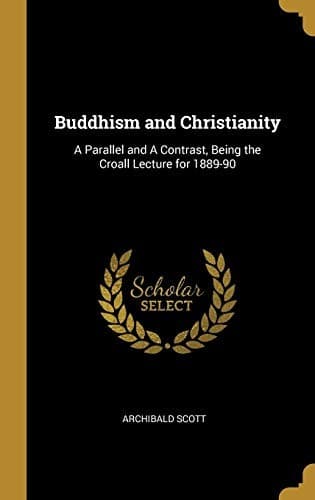
Buddhism and Christianity: A Parallel and a ContrastScott, Archibald
Religion
Buddhism and Christianity: A Parallel and a Contrast
Scott, Archibald
Buddhism -- Relations -- Christianity; Christianity and other religions -- Buddhism
world of Christendom which confronts us now.
Another significant contrast between the two sets of writings is found
in the fact that while we can dissociate the miraculous elements from
the Buddhist Pitakas without detriment to their other contents, we find
it impossible to apply the same process with the like results to the New
Testament. No one questions that primitive Buddhism is improved by being
freed from the portents which subsequently gathered around it, for
primitive Buddhism is an intellectual and moral system, a theory of the
universe more likely to be obscured than elucidated by an appeal to the
supernatural. Christianity, however, while appealing both to intellect
and conscience, does so as the revelation of a life which, as a new
thing, might break through all men’s conceptions of what was ordinary or
necessary. The first appearance of life on this planet as an unwonted
phenomenon would be accompanied by manifestations miraculous to all who
only judged by experience of what had already been. So would be the
first appearance of man to those who judged of things by what was
possible to the actual animal world. That the manifestation of One who
had come that men might have life, and have it more abundantly, should
be accompanied with phenomena new and strange to mankind might have been
expected. Christ, as revealing an ideal of excellence to which things as
they are in nature, and men as they now are in society, do not conform,
will in truth contradict the present working of both. This at least is
the impression inevitably produced by the reading of the New Testament.
Its teaching is throughout founded upon, and it would be quite
unintelligible without reference to, the supernatural. To dissociate the
miraculous portions from the rest of its contents would be not only to
mutilate but to destroy it.[167] Not the theological and metaphysical
elements only, but even “the ethical, are so interwoven into one fibre
with the supernatural in the New Testament that it is impossible to
detach them without destroying the whole fabric.”[168] Verily a Gospel
without the miracles and all that accounts for them would be a very
strange book.
Public-domain text, read in full here on John Shaqi.
Reviews
Reviews
No reviews yet
Be the first to share your thoughts on this work.
Elsewhere in the archive
Join the Discussion
Join the discussion
Sign in to leave a comment or review.
Sign InorCreate an account