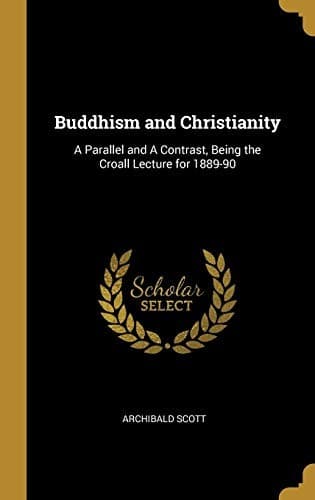
Buddhism and Christianity: A Parallel and a ContrastScott, Archibald
Religion
Buddhism and Christianity: A Parallel and a Contrast
Scott, Archibald
Buddhism -- Relations -- Christianity; Christianity and other religions -- Buddhism
establish the kingdom of God. Christ’s miracles were all signs of man’s
present and prophecies of his future relations to all the evils that
afflict him. They all remind us of the Divine original ideal that man,
perfectly obedient to God, must exercise dominion over His creatures in
this world. Man’s present antagonism to nature, and the disorder seen in
his own social relations, are alike due to his refusal to merge his will
in God’s, and the miracles of our Saviour are all prophecies that when
through obedience to or faith in God he shall be restored to holiness,
he will find his social and external relations improved, and will regain
over nature that spiritual authority which even already the winds and
the waves in part recognise and obey.[170]
Again, the New Testament writers claim for Christ what the early
disciples of Buddha never dreamed of claiming for their master, and they
insist upon their claim, though it is associated with the meanest and
apparently most contradictory of elements. It is not the glorification
but the humiliation of Christ which constitutes the marvel in the
Gospels. It was very natural that the Evangelists should imagine that
the angels should sing over the birth of a Saviour, but it was not
natural that they should conceive of them singing over a babe in a
manger. It was not wonderful, again, for Jews to believe that the coming
of their Messiah was divinely announced, but it is very wonderful that
they should believe that this annunciation was made to unknown
shepherds. It was certainly not in that way their Messiah was expected
to come. Had He come in the way they expected, the miracles might
naturally have been accounted for which they associated with His coming;
but, as matter of fact, it requires the miracle to account for their
belief in Him. And so it is all through in the Gospels. That the Messiah
should be discovered to be the Son of God need not surprise us, but that
the Son of God should be recognised by Jews in the form of a servant,
enduring patiently the contradiction of sinners, submitting to trial, to
torture, to death on the cross, is one of the greatest marvels in the
whole history of religion. This combination of glory and shame was a
difficulty in the way of faith, not a help or support of it. The claim,
we must remember, was not advanced for Christ by the Evangelists after
He died; it was formulated by Himself, and by Him it was asserted more
conspicuously, and with greater frequency and emphasis toward the close
of His earthly life. It was the only charge on which He was condemned;
all other accusations brought against Him broke down; but this one He
admitted—that He called Himself the Son of God. Questioned upon it, He
would not retract. “Thou sayest,” was all His reply, and for the saying
He was ordered to the cross. Yet upon the cross His assertion was
strengthened. Had He been a pretender, He would never have so comported
Himself before Pilate and Herod; had He been self-deluded, He never
Public-domain text, read in full here on John Shaqi.
Reviews
Reviews
No reviews yet
Be the first to share your thoughts on this work.
Elsewhere in the archive
Join the Discussion
Join the discussion
Sign in to leave a comment or review.
Sign InorCreate an account