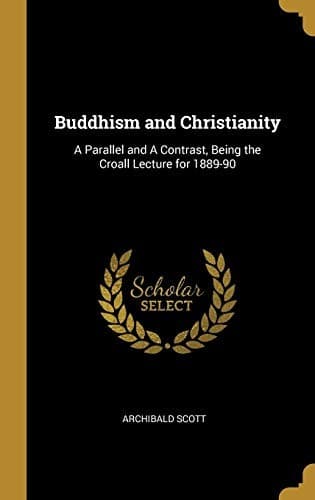
Buddhism and Christianity: A Parallel and a ContrastScott, Archibald
Religion
Buddhism and Christianity: A Parallel and a Contrast
Scott, Archibald
Buddhism -- Relations -- Christianity; Christianity and other religions -- Buddhism
Another very distinctive feature in the New Testament accounts is
displayed in the character of the wonders there recorded. Indeed, this
distinguishing element is found in all the miraculous narratives of the
Bible. If it be true that the ancient writers or redactors of Scripture
have employed the legends of other nations to illustrate their works, it
must be conceded that they have immensely improved, and made a much
better use of them. The story of the creation of the world, of the
primeval paradise, and of the deluge, may be only myths common to
several nations, but somehow, while all other writers just lose
themselves in these myths, the Hebrews alone have laid hold of them to
enforce the sublimest views ever formulated in human speech concerning
the origin of the world and of man. The narratives of the Old Testament
are evidently not constructed to startle the reader with portents, but
to disclose the providential dealings of a holy and merciful God with
man to enlighten and save him. The Gospels in like manner are not
written to record miraculous occurrences, nor are miracles introduced to
glorify Christ: they are simply referred to as incidents in His
ministry. When we compare the prodigies ascribed to Buddha during the
many changes of his pre-existence, or during his ministry, with the
miracles of the Gospels, they are like the rough casts in clay or wood
made by a rude or childish people contrasted with the perfect
productions of nature in the world of animals or of men. They may endure
comparison with the portents found in the Apocryphal books, or in the
Lives of the Saints, but placed side by side with the Gospel miracles
they serve only to illustrate the difference between what is artificial
and grotesque, and what is original and natural. There is a marked
sobriety in the Gospel accounts totally lacking in the Buddhist legends.
The latter serve no other end but to exalt and magnify Buddha,[169] but
the Gospel miracles are all founded in some great human necessity which
they are intended to supply. The Buddhist marvels are simply produced to
startle us, the Christian are recorded as signs to instruct us. What a
gulf separates the conception of Buddha leaping high in air amid the
sounding of the bells of the heavens and the plaudits of all the gods,
just to prove that he was Buddha, from the account of Christ’s refusal
to work a miracle to win the adherence of the crowd, or give the sign
from heaven to vanquish Sadducean unbelief! The Gospel miracles are few
after all, but they all flow from and are in harmony with the original
idea of Christ as Messiah which is assumed in all the Gospels. The
mighty works done by Him are all such as might be expected to be done in
a world like this by the Son of a heavenly Father. The cure of all
manner of disease, the exorcism of all the evil spirits that have
afflicted humanity, the victory over death, the control of all the
forces of nature, were all in the scope of one who came hither to
Public-domain text, read in full here on John Shaqi.
Reviews
Reviews
No reviews yet
Be the first to share your thoughts on this work.
Elsewhere in the archive
Join the Discussion
Join the discussion
Sign in to leave a comment or review.
Sign InorCreate an account