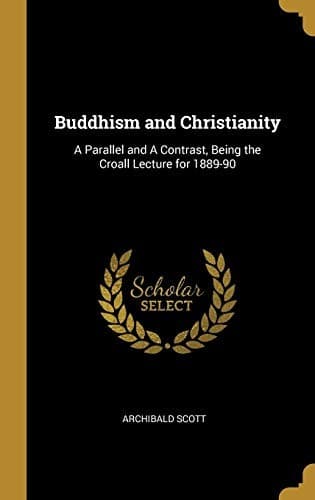
Buddhism and Christianity: A Parallel and a ContrastScott, Archibald
Religion
Buddhism and Christianity: A Parallel and a Contrast
Scott, Archibald
Buddhism -- Relations -- Christianity; Christianity and other religions -- Buddhism
We have no desire to exaggerate the value of the miraculous elements in
Christianity, but it does not appear to be true wisdom that would
depreciate them or ignore them altogether. Miracles by many have been
wrongly considered, and they have been often expounded by the advocates
of Christianity in such a way as to create instead of removing
difficulties connected with the faith. On the other hand, many who
reject or refuse to consider them seem afflicted by a kind of mental
semeiophobia which in its own way may be as dangerous an affliction as
hydrophobia is. The proper way is to consider them in relation to the
nature and purpose of the Revelation with which they are associated. The
miracle may sometimes be found only in the form of the narrative, as a
hieroglyph whose purpose we are too lazy to search for, whose meaning we
are too stupid to elucidate. The theory that miracles are only
figurative expressions of spiritual truth is not true, as it is
generally expounded; but it has a truth in it which must never be
overlooked. Every miracle is a parable, and every parable is a miracle.
It is the spiritual reality revealed by both which gives them value, and
not the wonder in them by which we are at first arrested. Yet without
the wonder to arrest us we might never have received the revelation.
“What did the apostle mean,” asks Robert Elsmere,[172] “by death to sin
and self? what the precise idea attached by him to being risen with
Christ? Are this death and resurrection necessarily dependent upon
certain alleged historical events, or are they not primarily, and were
there not, even in Paul’s mind, two aspects of a spiritual process
perpetually re-enacted in the soul of man, and constituting the
veritable revelation of God? Which is the stable and lasting witness of
the Father? the spiritual history of the individual and of the world, or
the envelope of miracle to which hitherto mankind has attached such
importance?” The envelope certainly would be as worthless without the
message which it carries as a husk from which the kernel has dropped.
Would St. Paul, however, ever have conceived the spiritual truths
referred to, if they had not been suggested by historical facts? Could
he ever have conceived of a death to sin had the world never witnessed
the death of the Holy Christ upon the cross? Could he ever have dreamed
of rising again in the power of a new life if the tomb in the garden
nigh Golgotha had never been found empty of its crucified occupant? Is
he not just suggesting the significance of very exceptional historical
events? He may be wrong in his interpretation, but there can be no
mistake that the interpretation is founded upon the history, that it was
the event which originated his theory, and not his theory that produced
the story of the event. Christian theology, instead of giving this
miraculous character to the tragic story of the life and death of
Christ, has been called into existence by man’s endeavours to account
Public-domain text, read in full here on John Shaqi.
Reviews
Reviews
No reviews yet
Be the first to share your thoughts on this work.
Elsewhere in the archive
Join the Discussion
Join the discussion
Sign in to leave a comment or review.
Sign InorCreate an account