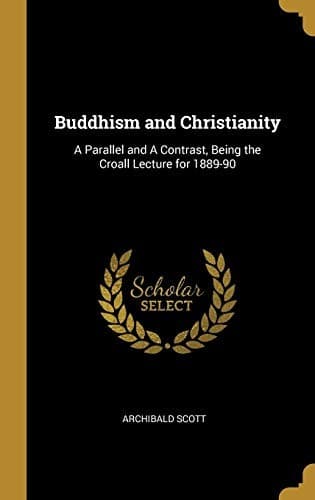
Buddhism and Christianity: A Parallel and a ContrastScott, Archibald
Religion
Buddhism and Christianity: A Parallel and a Contrast
Scott, Archibald
Buddhism -- Relations -- Christianity; Christianity and other religions -- Buddhism
for it as a fact not only marvellous, but simply unique in the
experience of mankind.
It is not likely that the miraculous elements in the Christian religion
will be found to be “the produce of its primitive theology, which will
fade out of the conception of men as theology advances and becomes
purified.” The demonstration of this must not be assumed to be complete
because the miraculous is also found in other religions. We must be able
to account for it in all of them. It is, indeed, the natural tendency of
humanity to magnify and eventually to deify its heroes, to embellish
their careers with similar marvels, to apply to them figurative language
very liable to be misunderstood, which in later generations hardens into
erroneous beliefs. That Christians as well as Buddhists have done so is
sufficiently attested by the apocryphal Gospels, but we must not
conclude that because there are so many fictitious and counterfeit
wonders in currency there can be no real miracles. We must examine each
religion on its merits, and its miraculous elements in the light of
their purpose and of their actual genesis; and if we do so in the case
of Christianity, we will probably discover the one supernatural reality
from which the shadows in all other religions are reflected, and to
which they all point.[173]
Dr. Rhys Davids, in the Hibbert Lectures, informs us that the early
Buddhist conception of Gotama was dominated and transformed by two
ideals, neither of which had any necessary connection with the man
himself. One of them, due to political experience, made him finally
assume in the popular imagination the office of a Universal King; while
the other, due to philosophic speculation, invested him with the
attribute of Perfect Wisdom. The implied parallel between this
conception, coloured as it grew by the sun myths which it incorporated,
and the Christian conception of Jesus, suggested by the titles King of
Glory and Divine Word, is obvious to everybody. Yet examination of the
supposed similarities only reveals essential contrasts between the two
sets of beliefs. The political experiences in India which are referred
to occurred about two centuries after the death of Buddha. The victories
of Chandragupta, resulting in the consolidation of a kingdom such as
Indians had never before witnessed, combined with his patronage of the
Buddhist monks, may have suggested the idea of the universal monarch.
“His achievements recalled the nearly forgotten poetry of the Vedic
legends, while the new and popular ethics of Buddha invested him with a
righteousness which made him a worthy Lord of the Four Quarters (of the
Globe).” So in one of the Suttas, said to be early, and which may have
been assuming shape at this time, words like these are put in the mouth
of Buddha:—“I am a king, O Sela, an incomparable, religious king; with
justice I roll the wheel, the wheel that is irresistible.”[174] With
this conception of Cakka-vatti, a glorious king, was connected, avers
Dr.
Public-domain text, read in full here on John Shaqi.
Reviews
Reviews
No reviews yet
Be the first to share your thoughts on this work.
Elsewhere in the archive
Join the Discussion
Join the discussion
Sign in to leave a comment or review.
Sign InorCreate an account