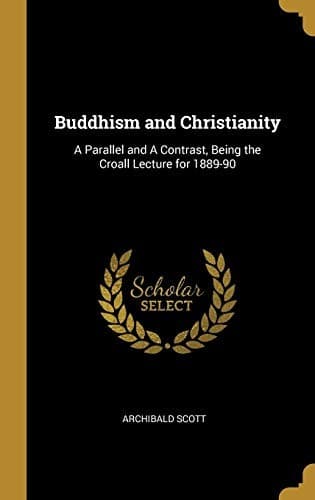
Buddhism and Christianity: A Parallel and a ContrastScott, Archibald
Religion
Buddhism and Christianity: A Parallel and a Contrast
Scott, Archibald
Buddhism -- Relations -- Christianity; Christianity and other religions -- Buddhism
The ideas suggested by the “Angel of the Presence” in the historic and
prophetic books, by the “Word of the Lord” in the Psalms, and by
“Wisdom” in the Books of Wisdom, indicate the rays which converge in St.
John’s doctrine of the Christ. As one who tarried long after the first
generation of Christians had gone to their rest, as one who had not only
pondered longer, and in deeper silence, the Life he had seen manifested,
but who had found its interpretation in such providences as the
spreading of the Churches and the destruction of the State, he was abler
to meet the necessities of a wider age, by setting the truth in rounder
form and clearer light; but while he expands and expounds the teaching
of the first generation, he adds and introduces not a single element.
His testimony is identical with that proclaimed at the Resurrection,
that Jesus of Nazareth is the Christ, and that Christ is the only
begotten Son of God.
It is not as one who has acquired truth by long struggle, not as one who
has fought or forced His way to light, that Christ presents Himself in
the Gospels, but as one who can say: “I am the way, the truth, the
life,” “the light of the world.” Yet along with this stupendous demand
upon the faith of humanity there is a humility and simplicity
undiscoverable in the Buddha of the Pitakas. Self-consciousness,
self-reliance, self-culture—these are the phrases most suggestive of the
system and of the life of the great Indian sage, while not
self-abasement, but self-oblivion, characterises the teaching and life
of Jesus of Nazareth. Identity with the Highest, manifested by absolute
surrender to Him, is the essence of the Revelation of Christ. Always is
the Father confessed to be the source of all grace and truth, and if the
Son asks to be glorified, it is that the Father may be glorified in Him.
We are certainly not contemplating similarities when we look at the
Buddha of the Suttas and the Christ of the Gospels, but contrasts more
widely separated than the soul is from the body. In Buddha we have a
historical personage, who can be thoroughly accounted for as the product
and outgrowth of his past, and of his environment; in Christ we have one
whom no philosophy of history has ever explained. Alone and
unapproachable, He meets us as one who is really human, because He has
become man, one who has arisen among men to save them, but because He
has come through and to them. He is not just one of the many, a son of
men, the product of a divinely-trained humanity, but the Son of Man, who
as Son of God, incarnated in the nature of all men, has become the Head
and Creator of a new humanity. Correct, improve, embellish as we may,
the portrait left us of the gentle teacher of Magadha, we never can lift
him up to that level which would justify his being worshipped or being
addressed, as Jesus of Nazareth has been by the consensus of all the
Christian ages, “Thou art the King of Glory, O Christ. Thou art the
everlasting Son of the Father.”
Public-domain text, read in full here on John Shaqi.
Reviews
Reviews
No reviews yet
Be the first to share your thoughts on this work.
Elsewhere in the archive
Join the Discussion
Join the discussion
Sign in to leave a comment or review.
Sign InorCreate an account