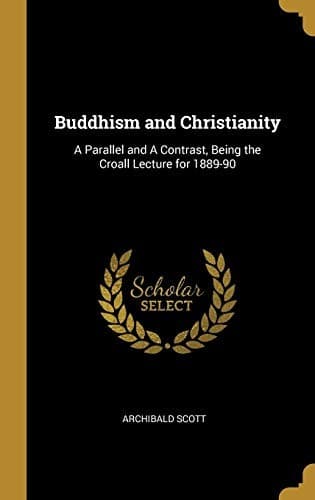
Buddhism and Christianity: A Parallel and a ContrastScott, Archibald
Religion
Buddhism and Christianity: A Parallel and a Contrast
Scott, Archibald
Buddhism -- Relations -- Christianity; Christianity and other religions -- Buddhism
This is not the place to discuss the substance of their respective
teachings. Their aims seemed to be similar, for both proclaimed
freedom to be gained by the Truth, or saving knowledge, but their
conceptions of the knowledge that saves are as widely contrasted as
are their ideas of salvation. If we put the Sermon on the Mount side
by side with Buddha’s first sermon (translated in vol. xi. p. 146 of
_Sacred Books of the East_) we find contradiction in almost every
sentence. “Blessed are the poor in spirit” is an utterance not only
foreign to but in direct antithesis to the preaching of Buddha. He has
no sympathy with the “poor in spirit,” if we take the phrase in the
light of the old Hebrew concept of it. His benediction is reserved for
the self-conscious and self-reliant, who are bent upon self-culture
and self-development. “Thou shalt love the Lord thy God with all thy
heart, etc., and thy neighbour as thyself.” Buddha found no higher to
adore, and no other than self to consider. The moral precepts in his
law are based on no appeal to conscience, and are inspired by no sense
of duty. Others were regarded as the occasion for winning merit, and
kindness done to them was not done for their sake, but with the view
of securing the safety of the doer.
Footnote 141:
Dr. Oldenberg (_Buddha, etc._, p. 148) very properly remarks that
Ambapali the courtesan was no Mary Magdalene, and that she was not
regarded by Buddha as the woman that was a sinner was regarded by
Christ. Buddha had not Christ’s horror of sin, and therefore felt none
of His boundless pity for the frailty of its victims; of hatred of sin
in the Christian sense Buddhism knows nothing. Its highest virtue is
imperturbability, a serenity that is apathetic in regard to the most
outrageous wrong or the most heinous wickedness. Cariya Pitaka, iii.
15; also _Sacred Books of the East_, vol. x. Part ii. p. 151.
Footnote 142:
Bishop Bigandet, _Life of Gaudama_, p. 287; Professor H. Wilson,
_Essays_, vol. ii. p. 243; Wheeler, _History of India_, vol. iii. p.
139; Oldenberg, _Buddha, etc._, p. 148; Mahâparanibhâna Sutta, in
_Sacred Books of the East_, vol. xi. pp. 71, 72.
Footnote 143:
Mahâparanibhâna Sutta, vi. 10, _Sacred Books of the East_, vol. xi. p.
114. Dr. Edkins, in _Chinese Buddhism_, p. 57, gives a version of an
appearance of Buddha after cremation to his mother, Máya, who came
down from heaven to see his coffin. Professor Childers finds no trace
in any Pali earliest literature of any belief in Buddha’s existence
after death (_Dictionary of Pali Language_, p. 472, note 1).
Footnote 144:
Oldenberg, _Buddha, etc._, pp. 322, 323; Kuenen, Hibbert Lectures, p.
264.
Footnote 145:
Public-domain text, read in full here on John Shaqi.
Reviews
Reviews
No reviews yet
Be the first to share your thoughts on this work.
Elsewhere in the archive
Join the Discussion
Join the discussion
Sign in to leave a comment or review.
Sign InorCreate an account