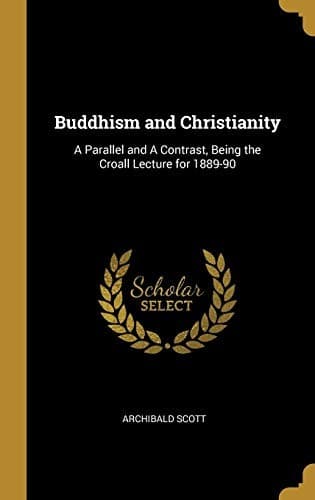
Buddhism and Christianity: A Parallel and a ContrastScott, Archibald
Religion
Buddhism and Christianity: A Parallel and a Contrast
Scott, Archibald
Buddhism -- Relations -- Christianity; Christianity and other religions -- Buddhism
The dogma of transmigration is said to occupy in the Buddhist system a
position analogous to that of the Fall in our Christian theology; but in
reality the two are diametrically opposed, both in their essential ideas
and the consequences which flow from them. They are analogous only in
respect that they each profess to account for the conflict between man’s
ideal of himself and his actual condition. The existence of evil is
admitted by both, but the Buddhist believes that evil belongs to the
very essence of man, and therefore he can find no prospect of relief
from it, here or hereafter. For as long as the stream of existence
continues it will always fall below its source, and evil, according to
the inexorable rule of nature, will propagate only evil. The Hebrew,
however, did not conceive of it as essential to or as always in the
nature of man. His ancestral beliefs carry him beyond the Fall; his
pedigree starts with the most sublime of all theories of human origin
that has ever been formulated in human speech: “Let us make man in our
image and after our likeness, and let him have dominion over” the
creature. Dominion over nature man has not, for he is too much under its
dominion, and to this subjection much of his suffering is directly
traceable. The Hebrew professed to have the origin of this condition
revealed to him in a breach between man and his Maker, consequent upon
man’s self-assertion and selfish withdrawal of his life from the source
of life, which must involve suffering and death. So through all the
weary generations there is the same invariable sequence of sin entering
the world, and death by sin. And yet at his very worst the Hebrew
believed that it was once far better with the human race, and on this
belief he dared to rear the structure of his magnificent hope, that
mankind shall be restored to the original close relationship with God,
and therefore to a grander dominion over nature, and to a happier and
even more prosperous life than that of which his ancestors had dreamed
as their primeval state.
Public-domain text, read in full here on John Shaqi.
Reviews
Reviews
No reviews yet
Be the first to share your thoughts on this work.
Elsewhere in the archive
Join the Discussion
Join the discussion
Sign in to leave a comment or review.
Sign InorCreate an account