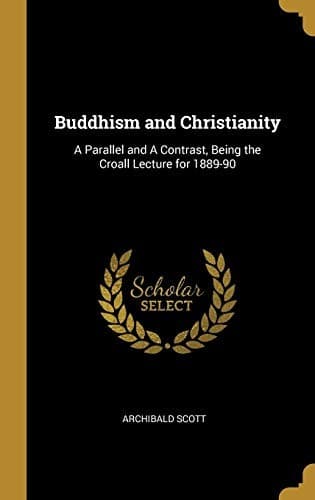
Buddhism and Christianity: A Parallel and a ContrastScott, Archibald
Religion
Buddhism and Christianity: A Parallel and a Contrast
Scott, Archibald
Buddhism -- Relations -- Christianity; Christianity and other religions -- Buddhism
Whatever may be said of the doctrine of the Fall, belief in it is indeed
“a condition of hope,”[188] and the belief and the hope both spring from
their faith in God as Creator and Governor of the race, which
characterised the Hebrew prophets. Wherever that faith is lively, it not
only sustains man amid the sufferings of life, but it nerves him to
struggle with physical and moral evil to vanquish it. The purer the
faith the more resolute is the struggle; the holier the Deity becomes to
the thought of man the stronger becomes his conviction that life is a
blessing, and that all its struggles may conduce to peace. There is an
instinct which seems to suggest that there are worse things than
troubles, and that they may be blessings of no mean quality after all.
Christianity has made the startling revelation that suffering is not
peculiar to man, as the consequence of his perversity in traversing the
Divine order; for not only is Christ presented to us as the greatest
sufferer, but in Him God the highest and the holiest is disclosed as
involved in it, and as taking upon Himself the responsibilities and the
sufferings which our sin and need entail. But if in Christ there is
revealed the greatest sufferer, it is as one whose suffering is not in
vain. By suffering He conquers that which has produced it; by enduring
suffering He ends it; and He reigns and finds His blessedness in making
us partakers of His victory over it. So again Christianity, unlike other
religions which promise salvation _from_ suffering, offers salvation
_through_ suffering. It alone asserts the utility of suffering; others
regard it as evil, Christianity as evil overruled for good. Others
reckon it as a mere loss or waste, Christianity as something that may be
turned to profit as the condition and preparation for joy. Joy in the
Christian conception is not the reward of suffering, nor compensation
for suffering, but the fruit and issue of suffering which leads to it,
as travail leads to birth. So instead of evading or ignoring it, Christ
would have us recognise and acquiesce in it, and even be thankful for
it, as necessary not for our personal profit, but for the gain of
mankind. By His sufferings we are healed, and through our sufferings we
fill up what remains of His for the redemption of the world. Only
through “the long travail of ages yet to be” will there be born in the
evolution of God’s redemptive purpose that better race from which all
suffering shall have passed away, because disobedience will have had an
end. Fellowship in Christ’s sufferings has thus transfigured the
afflictions of all who believe in Him. Unlike the Indian, tortured by
endless change, without any evolution from low to higher, from evil or
imperfect to what is good and perfect, the Christian can endure
suffering not only patiently but also cheerfully, knowing that he is
suffering not just for his own sake, but that in ways mysterious he is
Public-domain text, read in full here on John Shaqi.
Reviews
Reviews
No reviews yet
Be the first to share your thoughts on this work.
Elsewhere in the archive
Join the Discussion
Join the discussion
Sign in to leave a comment or review.
Sign InorCreate an account