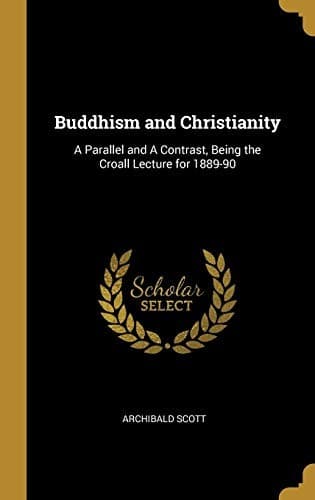
Buddhism and Christianity: A Parallel and a ContrastScott, Archibald
Religion
Buddhism and Christianity: A Parallel and a Contrast
Scott, Archibald
Buddhism -- Relations -- Christianity; Christianity and other religions -- Buddhism
The answer is to be sought for in the working of that great moral
instinct which is at the root of the belief in transmigration. Though
there was no person, no soul to emigrate from the body, though the man
perished, there was something which he called the Karma—a word coined by
old Brahman sages long before him, though used by them in a different
sense—that survived.[195] The aggregate of the good and evil in the life
that had come to an end formed the seed of another existence, so that
each new individual and generation became the exact and inevitable
results of those that had preceded them. It was evidently a theory of
continuity as unscientific as it was unphilosophic. It could not be
called an evolution in any sense of the word, seeing it meant the
appearance in a new individual of the mental and physical acts of
another who had ceased to be. The assertion, again, that though there
was no “continuing consciousness,” no transience of soul in any sense
from one person to the other, the two persons are one, has been very
properly stigmatised as a “psychological absurdity.”[196] From the
first, though one of their stablest dogmas, this one was a difficulty to
the Buddhists themselves. Their learned men never professed to justify
it to reason, but accepted it as a mystery, in open contradiction to
their principle that everything was to be rejected which could not be
comprehended or explained. The common people again simply ignored it,
and adhered to the belief of their fathers in continuity of life and
personal identity for man in the future. The sages might refine, but the
moral sense of the masses could not escape from the conviction that the
evil which they had done must follow them, and the good which they would
do could not be interred with their bones. Even the speculation of the
sages was a telling confirmation of the truth that man cannot get rid of
himself. He may make a mock at God, may demand, If a man die can he live
again? or how differs the life of a man from the life of a beast? but he
cannot refine away his moral sense and the instinct of retribution which
is inwoven in his inmost being. Buddha acknowledged no moral government
of Deity, discarded the old belief that the same soul must receive the
reward of the deeds done in the body; he denied even to the soul a
separate existence from the perishable body; but he was haunted by the
ghost of personal identity. He felt absolutely certain that there was a
real connection of cause and effect between past and present and future,
and that each act of the soul must work out its full effect to the
bitter end.[197] So it was only by profession that God was mocked; men
were witnesses to themselves of a Sovereign Power forcing Himself upon
them, even when they tried to forsake Him, compelling them to receive
His thoughts when they would not think for themselves. So in primitive
Buddhism we have the strange paradox that out of Atheism there arose a
Public-domain text, read in full here on John Shaqi.
Reviews
Reviews
No reviews yet
Be the first to share your thoughts on this work.
Elsewhere in the archive
Join the Discussion
Join the discussion
Sign in to leave a comment or review.
Sign InorCreate an account