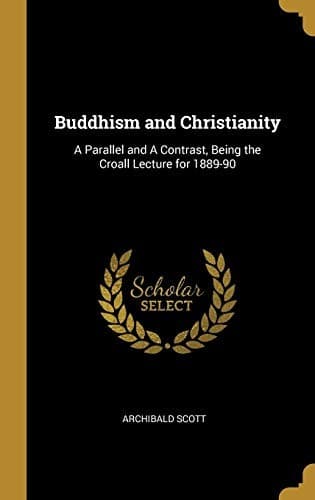
Buddhism and Christianity: A Parallel and a ContrastScott, Archibald
Religion
Buddhism and Christianity: A Parallel and a Contrast
Scott, Archibald
Buddhism -- Relations -- Christianity; Christianity and other religions -- Buddhism
religion, with a demand upon conscience almost Christian, and asserting
as Christianity does the eternal necessity of righteousness and
truth.[198]
The analogy which has been suggested between the Buddhist dogma of Karma
and the Christian doctrine of heredity is a very interesting one. It is
strange that the law of heredity, so clearly indicated in the Bible,
should be proclaimed in our age as a modern discovery. Infidelity
formerly denounced the Bible for teaching that sin and its penalty were
transmitted from generation to generation, forgetting that but for
transgression the law of heredity could only and always entail good.
Laws are to be judged by their intention, and this one, designed to
secure and transmit the increment of good in each generation, is
manifestly perverted by conditions for which it is not responsible. The
law, however, which asserts itself in humanity by entailing on the
generations the blessing of good as well as the curse of evil, is now
being proclaimed and interpreted, not by divines, but by men of science
and philosophy. The twin truth of the unity of humanity, elemental in
the Hebrew and Christian religions, though formerly strangely forgotten
or denounced by infidelity, is also adopted as a professed discovery of
our century. We are all agreed that humanity is one, that each life is
part of a larger life, and so the injury of the part is the injury of
the whole. Sin could not enter humanity without dragging it down, and
holiness could not enter and conquer without lifting it up. If one could
appear in humanity without sin, not a link in the diseased chain, but
perfectly free from all taint of disease, is the supposition incredible
that he would have the effect upon humanity of a new creation? His
coming would imply the reversal of the drift toward evil and the
weakening of the inherited and accumulated tendency to depravity. It
would be a bringing under Divine influence of this mysterious principle
of heredity, with results for good which no human intellect can measure,
and establish a once greatly derided assertion, that as in one Adam,
that is, one kind of humanity, all die, even so in Christ shall all be
made alive.
Public-domain text, read in full here on John Shaqi.
Reviews
Reviews
No reviews yet
Be the first to share your thoughts on this work.
Elsewhere in the archive
Join the Discussion
Join the discussion
Sign in to leave a comment or review.
Sign InorCreate an account