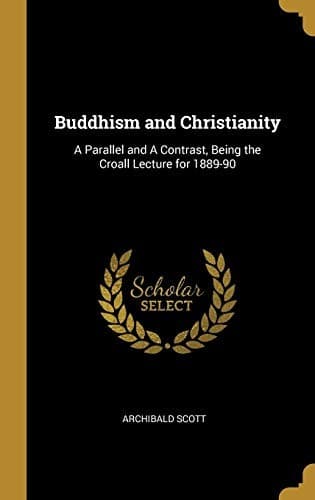
Buddhism and Christianity: A Parallel and a ContrastScott, Archibald
Religion
Buddhism and Christianity: A Parallel and a Contrast
Scott, Archibald
Buddhism -- Relations -- Christianity; Christianity and other religions -- Buddhism
Buddha had a clear apprehension of the truth of heredity, but he had not
the faintest conception of the unity of humanity. His theory of life was
essentially atomic. Humanity was not to him one whole, but a congeries
of individuals, each one an end to himself, and living just to himself.
The injury done to self by wrong-doing was always present to a
Buddhist’s thought, but the suffering thus caused to others was never
taken into account. He had no idea of the whole suffering in the one,
and consequently no sense of duty to mankind. Though believing in the
propagative power of good and evil, he did not work for the good of
coming generations, but solely for the rescue of the individual from the
whirlpool of suffering existence. It has been charitably suggested that
his aim finds its analogue in the offset to personal extinction so
winningly presented by “George Eliot” and Mr. John Morley, whereby
though dead and gone for ever in ourselves, we may “live again in minds
made better by our presence,” and “in pulses stirred to
generosity.”[199] Buddhism had no such hope; the age, the system itself,
were alike incapable of conceiving it. The time for that kind of
Positivism had not come. The human mind had to undergo long centuries of
Christian culture before it was possible for the nineteenth-century
agnostic poetess and philosopher thus to expound their creed, for modern
Positivism has been powerfully though indirectly influenced by the faith
which it contradicts, and, like many of the assailants of Christianity,
it owes to it the most of its strength and the best of its weapons.
Christianity, starting from the conception of man as no outgrowth of
nature, but a new creation in it, a being within and distinct from his
body as the driver is from the chariot,[200] has a theory of human
destiny contrasted utterly with that of Buddhism. Man’s teeth have been
set on edge because his fathers have eaten a sour grape, but the brand
of pain upon past transgressions helps him to conquer the taint
transmitted in the blood. Though he finds heavy temptation in inherited
tendencies, he finds in every temptation a way of escape in a call to
yield to other tendencies which are ever drawing his soul to goodness.
Sharing a confessedly sinful humanity, he may be partaker of a sinless
one, and thus, if evil reigns over him unto death, the law of the spirit
of life in Christ Jesus can free him from it.
Public-domain text, read in full here on John Shaqi.
Reviews
Reviews
No reviews yet
Be the first to share your thoughts on this work.
Elsewhere in the archive
Join the Discussion
Join the discussion
Sign in to leave a comment or review.
Sign InorCreate an account