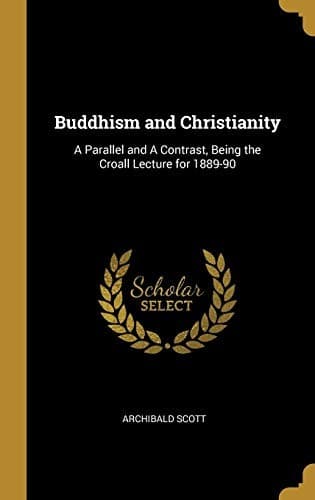
Buddhism and Christianity: A Parallel and a ContrastScott, Archibald
Religion
Buddhism and Christianity: A Parallel and a Contrast
Scott, Archibald
Buddhism -- Relations -- Christianity; Christianity and other religions -- Buddhism
The great question with Buddha and his immediate disciples was not how
Nirvana, the goal of human aspiration, was to be defined, but how it was
to be attained. It was for him sufficiently expressed as the final
extinction of all the roots of sorrow, and he taught that this
consummation could only be reached by knowledge. Ignorance was the
ultimate ground of all suffering existence, but, as in Christianity, men
could know the truth, and the truth would set them free. According to
both religions, this knowledge could neither be transmitted by tradition
nor learned by a simple intellectual process. It implied a moral and
spiritual training, and was the fruit of obedience; but there again the
analogy ends, for the Buddhist’s idea of knowledge is as widely
contrasted with the Christian idea as is its idea of the Truth to be
known. In Christianity knowledge means Divine illumination or
revelation, the result of trustful surrender to Christ, the revealer of
the Father, and Himself the Truth. In Buddhism it meant a knowledge
gained by man himself, through a process of moral culture and
self-control.[209] In Christianity it was a grace that came through
obedience to a better Will; in Buddhism it meant simply obedience to a
Law. That law, moreover, had no commanding power to enforce it, and
involved no moral obligation in the Christian sense to obey it. It was
not a law like the law of Moses or the law of Christ, for it implied no
Lawgiver to make it binding. It was simply a rule, a method, discovered
by man, and followed because he found it expedient to follow it.
Adopting this method, observing this rule, persevering in this course, a
man would attain to knowledge of the truth of things, but this supposed
truth is the very contradiction of the truth as it is in Jesus, the
truth by which we are sanctified, and made wise unto salvation.[210]
Public-domain text, read in full here on John Shaqi.
Reviews
Reviews
No reviews yet
Be the first to share your thoughts on this work.
Elsewhere in the archive
Join the Discussion
Join the discussion
Sign in to leave a comment or review.
Sign InorCreate an account