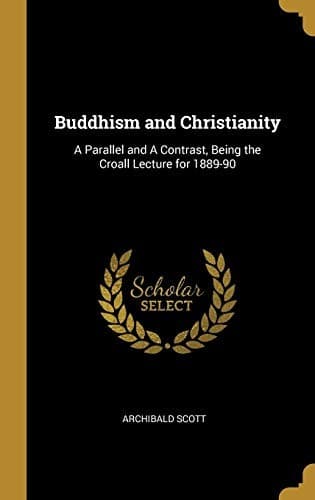
Buddhism and Christianity: A Parallel and a ContrastScott, Archibald
Religion
Buddhism and Christianity: A Parallel and a Contrast
Scott, Archibald
Buddhism -- Relations -- Christianity; Christianity and other religions -- Buddhism
This should be borne in mind when in translations of Buddhist books we
find such words as “holiness,” “saints,” “paths or degrees of
sanctification,” “righteousness,” and such like. The original words
represent conceptions different from and antagonistic to those suggested
by these words to us. But keeping this in view, we may well admire and
be thankful for the high purpose and clear moral insight which enabled
Buddha to discover and set forth his way to Nirvana. The strength and
glory of Buddhism, the secret of its original attractiveness, and of its
long continuance, is its ethical system. Its metaphysical creed may
represent a very puerile philosophy, its discipline of artificial
restraint may have been the reverse of emancipation, but its moral code,
in its simple and direct and powerful appeal to the conscience, is a far
nearer approach to the Gospel than that of Gentile Stoics or of Jewish
Scribes. Avoiding sensuality on the one hand as degrading, and
asceticism on the other as unprofitable, it mapped out a _via media_
that led far above that projected by any ancient school. It entered into
every domain of life, of thought and word and deed;[211] laid its
control, as Christianity does, on feeling and motive, and proclaimed
that the way to perfect peace was a way which no unrighteous man could
enter and no unclean man could tread.
It is very interesting to catch, behind all its superstitions and
idolatries, and crude and childish speculations, this glimpse of an
ideal like unto that of the Son of Man, calling and leading men to
righteousness, purity, and kindness, as their only refuge. To the old
Vedic religion, and to all the class of religions of which it is the
type, morality, as we have seen, was a stranger. It was the philosopher,
and not the priest, who in old times argued of righteousness,
temperance, and judgment to come. The Hebrew, as we have seen, was the
first and only ancient religion that demanded holiness of life as
indispensable to the worship of God, and Christianity, as was natural,
recognised this old law which men had from the beginning. But Buddhism
was the first system in which morality was substituted for religion. It
had neither priests, nor temples, nor prayers, but taught men to depend
for safety solely upon a life of virtue and wisdom and goodness. Though
it implied a change of heart amounting to conversion, this was due to
the operation of no regenerating spirit, but to perseverance in courses
within the reach of any one. Anticipating, therefore, theories of life
broached now-a-days as if they were new discoveries, its endeavour to
dissociate the human from the supernatural, and to substitute the
ethical for the religious, deserves very earnest study.
Public-domain text, read in full here on John Shaqi.
Reviews
Reviews
No reviews yet
Be the first to share your thoughts on this work.
Elsewhere in the archive
Join the Discussion
Join the discussion
Sign in to leave a comment or review.
Sign InorCreate an account