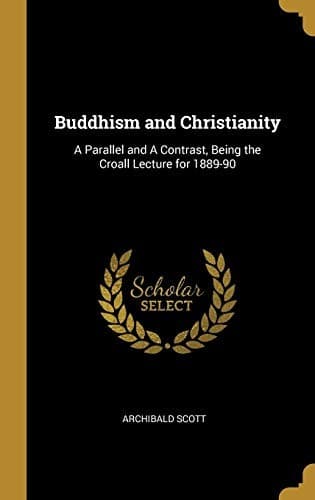
Buddhism and Christianity: A Parallel and a ContrastScott, Archibald
Religion
Buddhism and Christianity: A Parallel and a Contrast
Scott, Archibald
Buddhism -- Relations -- Christianity; Christianity and other religions -- Buddhism
Let us now examine more closely this way to Nirvana as expounded in the
Suttas of Buddha, and in relation to Christ’s way of salvation. The
Christian is very simple, but as it proceeds from a much deeper
conception of human need, its method of meeting it is very different. It
was not the suffering and misdirection of men that most deeply impressed
and most powerfully affected our Lord. He came to a race made in the
image of God, that had confessedly fallen from or had failed to realise
its ideal. It was lost, as sheep are lost, by inherent tendency to
wander; as coins are lost, by the neglect of others; as prodigals are
lost, by sensuality; and as Pharisees are lost, by self-righteousness.
It was diseased and perishing, struggling not in the coils of changeful
suffering, but in the clutch of an evil power which had taken possession
of it. Sorely needing, though not seeking redemption, unable to help
itself, He had come in the name of His Father, who willed not that any
should perish, to seek and save it. His formula of salvation was plain
enough for even babes to apprehend, for all He asked was that men should
turn to and believe in Him. They could not raise themselves, but they
could look toward Him, and find deliverance in the look, for by trust in
Him as the supreme object of love and worship, they would be lifted up
out of their evil state. The deepest tides of man’s being are those
which are swayed by his faith in and love of persons, and it was upon
faith, the commonest of all powers in our nature, that Christ relied for
the deliverance of mankind from the dominion of evil. He offered Himself
to man and for man, was lifted up for them on the cross in the beauty of
suffering holiness; and as love always attracts love, and as goodness
becomes a creative power in those who appreciate it, so all who believed
Him, trusted Him, clung to Him as the weak cling to the strong, were
uplifted, and changed, and transfigured. Love not only has a dominating
but an assimilating power. We become like those whom we fervently admire
and implicitly obey. Obedience in such a case is not an obligation, but
an inspiration; so though in Christianity we speak of the Law of Christ,
it is not as an external code to which we must conform, but as a power
communicated to and operative in us. It is a law of the _spirit of
life_, a grace and blessedness of disposition, which, springing from
gratitude, will manifest itself in holiness far exceeding the
righteousness of a law, because vivified by a charity and mercy as
boundless as that which it adores.
Public-domain text, read in full here on John Shaqi.
Reviews
Reviews
No reviews yet
Be the first to share your thoughts on this work.
Elsewhere in the archive
Join the Discussion
Join the discussion
Sign in to leave a comment or review.
Sign InorCreate an account