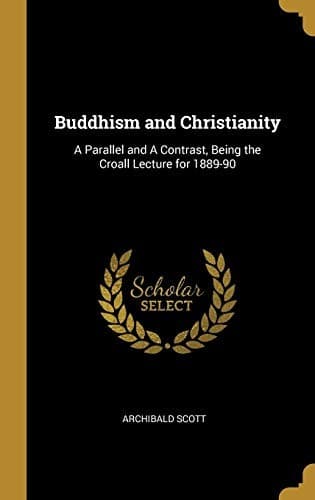
Buddhism and Christianity: A Parallel and a ContrastScott, Archibald
Religion
Buddhism and Christianity: A Parallel and a Contrast
Scott, Archibald
Buddhism -- Relations -- Christianity; Christianity and other religions -- Buddhism
So when our Lord inaugurated His kingdom, He may be said to have
proclaimed in the Beatitudes His Law, for He then declared the
dispositions of those who would receive Him, and who as sons of men
trusting and following Him, would be saved and sanctified and glorified
by the Son of God. Now, though from his first sermon to the last Buddha
is represented as “instructing his disciples, inciting them, rousing
them, and gladdening them” by discoursing of blessedness, it was not of
blessedness in the gospel sense. It was the blessedness of the Old
Covenant, not of the New—the blessedness, not of them who love much
because they have been forgiven much, but of them who keep the law, and
tread “the path which opens the eyes, bestows understanding, leads to
peace of mind and full enlightenment”—the blessedness all who, walking
in the Noble Eightfold Way, must eventually reach Nirvana.[213]
It is almost impossible to explain all that is meant by the Noble
Eightfold Way, for translators differ very greatly as to the real
meaning of the terms employed, and even when they agree, they warn us
that the words, though similar to our own, do not suggest the same
realities. The word “righteousness” and even “morality” never can have
on the lips of a true Buddhist the same signification which they have on
ours; for righteousness, apart from the fear and love of God, is an
impossible conception to us, and so would unrighteousness, unless as a
sin or an offence against Him. Buddhism has no word for ‘sin’ in our
sense, and therefore no words for ‘holiness’ or ‘saint.’ “Sin is simply
pain, demerit, and a saint is one freed from what causes pain.” “A
righteous act is one accumulating merit, an unrighteous act one
producing suffering.”[214] The Eightfold Way, interpreted by the
legends, presents us with the Buddhist conception of the perfect man,
and were we to take its constituents as equivalents to the Christian
qualities suggested by the words, we should find outlined a character
which here or anywhere must be its own beatitude, but whose blessedness
is as completely beyond the reach of sinful man as flying is beyond the
power of a bird whose pinions are broken.
Public-domain text, read in full here on John Shaqi.
Reviews
Reviews
No reviews yet
Be the first to share your thoughts on this work.
Elsewhere in the archive
Join the Discussion
Join the discussion
Sign in to leave a comment or review.
Sign InorCreate an account