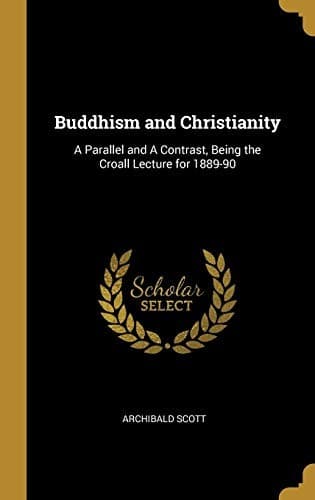
Buddhism and Christianity: A Parallel and a ContrastScott, Archibald
Religion
Buddhism and Christianity: A Parallel and a Contrast
Scott, Archibald
Buddhism -- Relations -- Christianity; Christianity and other religions -- Buddhism
But Right Views or Belief, Right Resolve, Right Speech, Right Work,
Right Livelihood, Right Exercise, Right Mindfulness, and Right
Tranquillity, must be taken, not as we accept, but as Buddhists
understand, the phrases. By right belief they unquestionably meant
belief in Buddha and the Four Verities; right resolve included
abandonment of all domestic and social duties; right speech was the
recitation or publication of the dharma; right work was specially that
of a monk; right livelihood that of living on alms; right exercise
tended to the suppression of all individuality; right mindfulness was
habitual contemplation upon the impurity and impermanence of human
nature; and right tranquillity was ecstasy.[215] To have substituted
even this in the Hindu mind for a righteousness only ceremonial and
superstitious was indeed reformation; but as an idea of Perfection it is
manifestly not only different from, but greatly inferior to, the
Christian ideal. Perfection in the case of Buddhism meant extinction of
feeling and consciousness; in Christianity it meant harmonious and full
development of being and character. In Christianity perfection meant
conformity to an Exemplar outside and above it, the likeness of a child
to a Father in heaven; but Buddhism could conceive of no exemplar, and
the man who would be perfect must strive in entire self-dependence to be
so. In Buddhism the standard is purely human; in Christianity, while the
measure required is relative, the standard is divine. So in Buddhism the
Arhat is content, and we never hear from him the confession, “I count
not myself to have attained!” but in Christianity the more saintly the
life, the greater the discontent with it. The higher we rise the more
urgent is the desire to press on. Christianity therefore opens up the
avenue to perpetual improvement, and inspiring us with a motive to
progress which can never lose its power, it provides for the soul the
only rest that will satisfy it. “In life,” says Pascal, “we are ever
believing, we seek repose, but what we really crave is agitation.” “It
is the contest that pleases us, and not the victory; the pursuit and not
the possession.”[216] Absolute truth and goodness is the perfection of
divine blessedness; the never-ceasing pursuit of it is human
blessedness. The goal we can never reach, but the watchword, “Nearer, my
God, to Thee!” seems to solve for us the problem of human destiny, for
by directing us to the life of perpetual achievement, it assures us of a
never-ending blessedness.
Public-domain text, read in full here on John Shaqi.
Reviews
Reviews
No reviews yet
Be the first to share your thoughts on this work.
Elsewhere in the archive
Join the Discussion
Join the discussion
Sign in to leave a comment or review.
Sign InorCreate an account