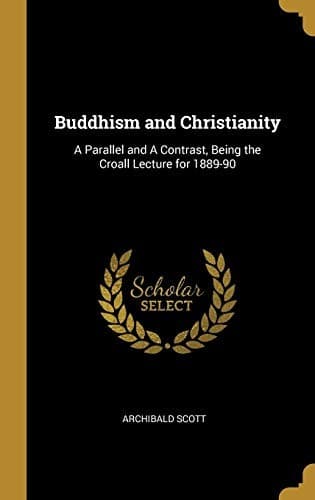
Buddhism and Christianity: A Parallel and a ContrastScott, Archibald
Religion
Buddhism and Christianity: A Parallel and a Contrast
Scott, Archibald
Buddhism -- Relations -- Christianity; Christianity and other religions -- Buddhism
It is alleged that in Pali literature the word for meditation
(_samadhi_), by which alone inner purity can be attained, bears to the
word for “uprightness” the same relation as that which faith in the New
Testament bears to works.[229] By uprightness, delusion is cleared away,
and by pondering constantly the five principal kinds of
meditations—Love, Pity, Joy, the Impurity of the Body, and the state of
Serene Indifference to what men think bad or good—the man was supposed
to be redeemed from all attachment.[230] It is very pathetic to note
this approach toward and yet rebound from the Christian conception of
the function of faith: for faith is the victory that overcometh the
world, with its lust of the flesh, its lust of the eye, and its pride of
life. It is that too which, because it looks to the unseen and eternal,
quenches all sordid or inordinate cleaving to life, which is the root of
so much evil and the cause of so much suffering. The apostles,
instructed of Christ, have taught us that God’s precious gift of life is
ours to use: that to keep it, to will to save and to find it, as if it
were an end and not a means, is to miss and to lose it; while to use it,
be willing to lose it for some higher good, is to keep it unto life
eternal. Now Buddha had a glimpse of this truth, that lust of existence
was the root of bitterness in humanity. He condemned as heresies the
worldly lust which says, “Let us eat and drink, for to-morrow we die,”
and the lust of other-worldliness which dreams that the life beyond will
yield as good, or better pleasures than this one;[231] but the two last
of his five principal meditations show how far apart and far short of
the victory of faith was his idea of the victory of samadhi. The
apostles’ aim was to get rid of lust; but his aim was to get rid of
life. The apostles mortified the members which are upon the earth,
anger, wrath, malice, evil concupiscence, and covetousness, just that
the higher life, the life hid with Christ in God, might grow and
brighten; but Buddha, in “cleansing himself from all impurity, little by
little, moment by moment, piece by piece,”[232] sought to escape from
the last shadow of personal existence into the blessedness of absolute
unconsciousness, if not of utter extinction.
Public-domain text, read in full here on John Shaqi.
Reviews
Reviews
No reviews yet
Be the first to share your thoughts on this work.
Elsewhere in the archive
Join the Discussion
Join the discussion
Sign in to leave a comment or review.
Sign InorCreate an account