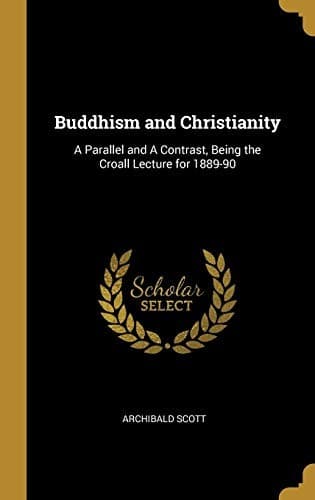
Buddhism and Christianity: A Parallel and a ContrastScott, Archibald
Religion
Buddhism and Christianity: A Parallel and a Contrast
Scott, Archibald
Buddhism -- Relations -- Christianity; Christianity and other religions -- Buddhism
For this seems clearly revealed in the last or highest stage to which
the paths of uprightness and meditation were supposed to conduct, that
of enlightenment (_panna_) or spiritual abstraction, alleged to be
equivalent to prayer in other religions. The highest Christian
conception of prayer is that of communion with God; the highest Buddhist
conception of _panna_ is of a state of clairvoyance or ecstatic insight
in which “men hear with clear and heavenly ear, surpassing that of men,”
and “comprehend by their own hearts the hearts of other men,” and
“recall their own various states in former existences,” and “see with
pure and heavenly vision the procession of other beings as they pass
from life to life.”[233] Buddha evidently was believed by his disciples
to have possessed this power, and probably his own long fasting and
severe austerities, practised in the beginning of his career, acting
upon a highly nervous system, made him a believer in the reality of this
perfect insight and ecstasy of contemplation, and that it might be
acquired by all who were sufficiently persevering in pursuit of
Arhatship.[234] It must be observed, however, that he does not appear to
have regarded this as an experience to be enjoyed by the Arhat in
perpetuity; on the contrary, it was the condition preceding final and
eternal deliverance, and so it may be taken as the Buddhist conception
of Euthanasia.
The Christian in the highest and supreme moment of life aspires, if
conscious, after the beatific vision. It is no Brahmanic absorption into
the absolute that he desires, but likeness to and communion with God.
The consciousness of personality was never more intense, the conviction
was never stronger that he has been divinely created and trained as a
separate character. By long and prayerful use of the means of grace he
has sought to bring, and to keep himself under the control of the Holy
Spirit; and he hopes that the next change will completely free him from
every trace of “sensuality, delusion, and ignorance,” and purge away
from the soul the last taint of selfishness. By long and sore
experiences he has learned that selfishness is the evil root whence
spring all the suffering and sorrow that poison life. He can therefore
understand and sympathise with the Buddhist anathema upon
“individuality,” if by that is meant the endeavour to abstract our life
from the solidarity of humanity, to use it for our own ends, and to
grudge what of it God uses for the rest of His family. This is the
Christian conception of the cause of death and all its woe, and from
this a Christian saint ever prays and struggles to be free; but it is
not from “individuality” in this sense that the Buddhist Arhat seeks
deliverance. He is bent upon the very thing from which the Christian is
anxious to escape. He wants to isolate and withdraw his portion of life
from the sum of humanity, to abstract himself from the mass, to save his
own soul; and now that he nears the goal, his whole energies are
Public-domain text, read in full here on John Shaqi.
Reviews
Reviews
No reviews yet
Be the first to share your thoughts on this work.
Elsewhere in the archive
Join the Discussion
Join the discussion
Sign in to leave a comment or review.
Sign InorCreate an account