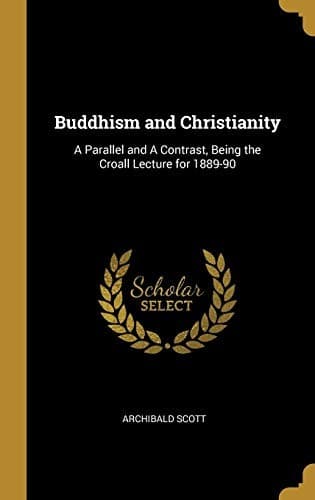
Buddhism and Christianity: A Parallel and a ContrastScott, Archibald
Religion
Buddhism and Christianity: A Parallel and a Contrast
Scott, Archibald
Buddhism -- Relations -- Christianity; Christianity and other religions -- Buddhism
Footnote 206:
Childers, _Pali Dictionary_, Art. NIRVANA.
Footnote 207:
Dr. Kellogg, in his _Light of Asia and Light of the World_, pp. 223,
252, protests very forcibly against the use by translators of the word
“immortality” as the equivalent of Nirvana. It meant, as he reminds
us, “the end of death indeed, but not because life had triumphed, but
because, life having ceased, death had nothing to feed on.”
Immortality, endless bliss, and kindred phrases, applied to it, are
only justifiable by the popular but really un-Buddhistic use of the
word Nirvana.
Footnote 208:
Isaiah xxxii. 11; James iii. 18.
Footnote 209:
Sir Monier Williams, _Buddhism_, pp. 97, 223.
Footnote 210:
“Not to know suffering, not to know the cause of suffering, not to
know the path that leads to the cessation of suffering—this is called
Ignorance.” Consequently knowledge of these things is saving
knowledge.—Mahavagga, _Sacred Books of the East_, vol. xiii. p. 75,
note 2.
Footnote 211:
This threefold division or “doorway” (Hardy, _Manual_, p. 491), once
considered by Weber to be peculiar to Buddhism, has been proved to be
common to Brahmans, Persians, Jews, and Greeks, as well as Christians.
See interesting note at pp. 28, 29, of vol. x. of _Sacred Books of the
East_, Part i.
Footnote 212:
Dr. Fairbairn, _Studies in Religion and Philosophy_, p. 161.
Footnote 213:
Dhamma. Sutta, 2-4; _Sacred Books of the East_, vol. xi. pp. 146, 147;
Mahavagga, i. 6. 17-20; _ibid._ vol. xiii. pp. 94, 95.
Footnote 214:
Sir Monier Williams, _Buddhism_, p. 124.
Footnote 215:
Frankfurter, App. to Wordsworth’s Bampton Lectures on _The One
Religion_, p. 348; Sutta Nipâta, _Sacred Books of the East_, vol. x.
p. 69.
Footnote 216:
_Pensées_, vol. ii. p. 34; vol. i. p. 205; ed. Faugère.
Footnote 217:
Spence Hardy, _Manual of Buddhism_, p. 506.
Footnote 218:
Sutta Nipâta, _Sacred Books of the East_, vol. x. pp. 33, 46, 67;
Dhammapada, 284.
Footnote 219:
_Sacred Books of the East_, vol. xi. pp. 60, 61.
Footnote 220:
Mahâparanibhâna Sutta, cap. iv. 4; _Sacred Books of the East_, vol.
xi.
Footnote 221:
Saint-Hilaire, _Le Bouddha, etc._, pp. 149, 153, 161.
Footnote 222:
Wordsworth, Bampton Lectures on _The One Religion_, p. 91.
Footnote 223:
Oldenberg, _Buddha, etc._, p. 289.
Footnote 224:
Meta Sutta, _Sacred Books of the East_, vol. x. p. 25.
Footnote 225:
See the story given in Mahavagga, x. 2. 3-20; also the story of
Kunala, Asoka’s son—this latter said by Burnouf, in his Introduction,
to be of modern origin. Quoted by Oldenberg, p. 290.
Footnote 226:
So Dr. Rhys Davids, _Buddhism_, p. 126. Fausböll translates, “Not
cultivating the society of,” etc. (Sutta Nipâta, _Sacred Books of the
East_, vol. x. pp. 43, 44.)
Footnote 227:
Dr. Edkins, _Chinese Buddhism_, p. 204.
Footnote 228:
Dhammapada, 157-8-9, 379-80; _Sacred Books of the East_, vol. i.
Footnote 229:
Public-domain text, read in full here on John Shaqi.
Reviews
Reviews
No reviews yet
Be the first to share your thoughts on this work.
Elsewhere in the archive
Join the Discussion
Join the discussion
Sign in to leave a comment or review.
Sign InorCreate an account