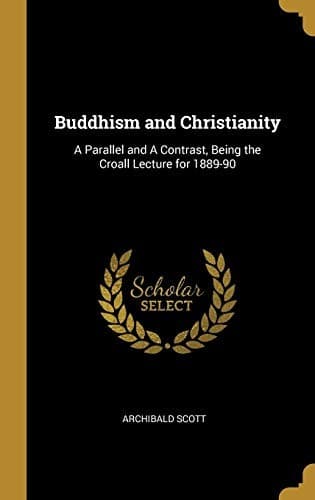
Buddhism and Christianity: A Parallel and a ContrastScott, Archibald
Religion
Buddhism and Christianity: A Parallel and a Contrast
Scott, Archibald
Buddhism -- Relations -- Christianity; Christianity and other religions -- Buddhism
T. W. Rhys Davids, in the Introduction to his translation of the Keto
Khila Sutta (Barrenness and Bondage), _Sacred Books of the East_, vol.
xi. p. 222, says that in reading it he was irresistibly reminded of 2
Peter i. 5-9. The barrenness referred to in the Sutta is lack of
successful effort to be free from “the Ten Fetters” which bind man to
existence, chief of which is hankering after immortality in any form,
or without form. How contrasted is this to St. Peter’s thought! “Give
diligence to provide in your faith earnestness,” that it may be an
overcoming faith; but as faith without knowledge is superstition, and
earnestness misdirected will do harm, provide in earnestness
“knowledge”; and as knowledge ungoverned will degenerate into conceit,
provide in it “temperance”; but temperance must be inspired with
“patience,” bent on God’s glory, not personal gain; “godliness” thus
attained, “brotherly kindness” will manifest itself, and then
“charity” toward every creature—that is the grace of our Lord Jesus
Christ, the _summum bonum_, the knowledge in which we are neither to
be barren nor unfruitful. No more forcible illustration of the utter
contradiction between the two religions could be found than this
verbal analogy of “barrenness and bondage.”
Footnote 230:
Compare St. Paul, Phil. iv. 8: “Finally, brethren, whatsoever things
are true, whatsoever things are honourable, whatsoever things are
just, whatsoever things are pure, whatsoever things are lovely,
whatsoever things are gracious; if there be any virtue, if there be
any praise, think on these things.”
Footnote 231:
Dhamma-Kakka-ppavattana Sutta, 6, note; _Sacred Books of the East_,
vol. xi. p. 148.
Footnote 232:
Dhammapada, 239; _ibid._ vol. x. p. 1.
Footnote 233:
Akankheya Sutta; _Sacred Books of the East_, vol. xi. p. 210.
Footnote 234:
If the legends are to be followed, he believed in the miraculous power
which resulted from it (see Mahâparanibhâna Sutta, i. 33, and iii. 22;
also Mahavagga, i. 20. 24), but he condemned the exercise of that
power for self-glorification or for paltry gain (Kullavagga, v. 8. 2;
also vii. 1, 2, 3; _Sacred Books of the East_, vols. xi. xii. xiii.).
Footnote 235:
See Gough, _Philosophy of the Upanishads_, pp. 267, 268.
Footnote 236:
Oldenberg, _Buddha, etc._, p. 314.
Footnote 237:
Sir Monier Williams, _Buddhism_, p. 35.
Footnote 238:
Saint-Hilaire, _Le Bouddha, etc._, p. 162.
Footnote 239:
Mr. Alabaster, _Wheel of the Law_, preface, p. xvi.
Footnote 240:
Eitel, _Lectures on Buddhism_, pp. 59-70; Saint-Hilaire, _Le Bouddha_,
p. 156.
Footnote 241:
Jackson’s Bampton Lectures, _The Doctrine of Retribution_, p. 284;
Caird’s _Philosophy of Religion_, Croall Lectures, pp. 259 _seq._
Footnote 242:
Saint-Hilaire, _Le Bouddha_, p. xxiii; Hardy’s _Eastern Monachism_, p.
312.
Footnote 243:
Public-domain text, read in full here on John Shaqi.
Reviews
Reviews
No reviews yet
Be the first to share your thoughts on this work.
Elsewhere in the archive
Join the Discussion
Join the discussion
Sign in to leave a comment or review.
Sign InorCreate an account