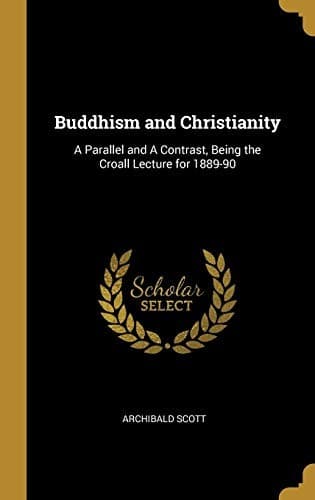
Buddhism and Christianity: A Parallel and a ContrastScott, Archibald
Religion
Buddhism and Christianity: A Parallel and a Contrast
Scott, Archibald
Buddhism -- Relations -- Christianity; Christianity and other religions -- Buddhism
The Church was the fruit of Christianity, but the Sangha was the root
out of which Buddhism sprang. In a Sangha its founder lived and learned
and taught, till as Buddha he founded his own; but just as he gave a new
significance to the doctrines in which he had been instructed, so he
gave the Sangha an application which accounts for, though it does not
justify, the designation often accorded to it of a church. As an order
without worship, a brotherhood without any recognition of the uniting
Fatherhood in heaven, a confraternity in which seniority was assigned
only to age,[246] and whose leaders never pretended to hold any priestly
office or to exercise any hierarchical authority, the Sangha at first
and for long was not a church; yet when we examine its constitution and
aims we need not wonder that the religious instincts of Buddhists,
proving stronger than their creed, should have developed their Sangha
into something like a church, with a cult which, at first consisting
only of veneration for his images and relics, for long has been almost
second to none in the world for solemnity and dignity and pomp.[247]
We have seen that philosophic schools and religious sects originating
in secessions from the national religion abounded in India long before
Buddha’s day. In the Gangetic valley, as in Greece, the new sages
attracted their disciples by the fame of their teaching, but there,
not as in Greece, the disciples lived with their masters apart, and
distinguished from the world by peculiar dress and manners. Of
Monachism, an early outgrowth of Hindu religion, and indeed its
essential adjunct, as being the state which marked the maturity and
completion of a good man’s earthly life, there were already many
forms, all held in high respect by the people. Celibacy and mendicancy
were common to all Sanghas, but in regard to vows of silence, and
fasting, and self-torture, they differed greatly from one another. The
majority of them were Brahman in their constitution and in their
recognition of caste: but long before the rise of Buddhism the Sraman
fraternities, founded on the non-recognition of caste, were quite
equal to the purest Brahman ones in public esteem. Now in organising
the Sakya-putta-Samanas, the designation by which his disciples were
first known by the people, Buddha adopted many features and details of
discipline common to all these fraternities, while yet the peculiarity
of his doctrines gave to the community of his own disciples a
character quite distinctive.
Public-domain text, read in full here on John Shaqi.
Reviews
Reviews
No reviews yet
Be the first to share your thoughts on this work.
Elsewhere in the archive
Join the Discussion
Join the discussion
Sign in to leave a comment or review.
Sign InorCreate an account