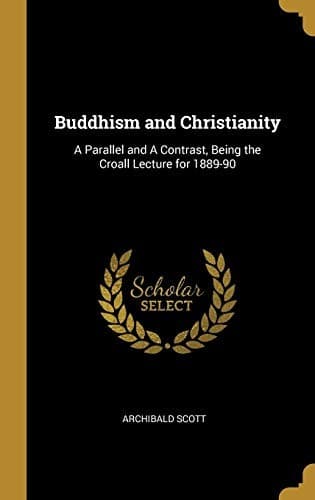
Buddhism and Christianity: A Parallel and a ContrastScott, Archibald
Religion
Buddhism and Christianity: A Parallel and a Contrast
Scott, Archibald
Buddhism -- Relations -- Christianity; Christianity and other religions -- Buddhism
“Prefix the name of God to this Declaration” (of the Rights of Man),
said Abbé Grégoire to the National Assembly in 1789, “or you leave it
without foundation, and make right the equivalent of force.” The
Assembly refused, but events soon confirmed his judgment.—Baring
Gould, _Development of Belief_, vol. ii. p. 88.
LECTURE V.
THE BUDDHIST SANGHA[244]: THE CHRISTIAN CHURCH.
The designation “Church,” never wholly applicable to Buddhism in the
sense in which Christians employ it, was totally inapplicable to the
primitive Buddhist communities. The institution of the Church is
peculiar to Christianity, for though we speak of the worship of Krishna,
or the religion of Baal, we never speak of the church of the one or the
other. Christianity is the only religion which has created a society
which no political revolution can destroy, and no civilisation, however
advanced, can outlive. It may change its form, or express itself in
several co-existent forms; but it is so adapted to the nature and
necessities of man that it is properly described, in its relation to his
present condition, as divine and everlasting.
Though the Church is the creation of Christ and the fruit of His
mission, the idea of it had been suggested to the world long ages before
He came. “Ecclesia” is peculiarly a New Testament word, but there are
found in the Old Testament Scriptures plain foreshadowings of the
reality represented by it. In Abraham, “called” out from his country and
kindred, that he might be separated unto the worship of Jehovah, we have
the first pre-intimation of the Church. In relation to other nations,
his descendants were the “peculiar people” and Ecclesia of Jehovah, and
when as a nation they failed to embody and express the universal truths,
which it is the Church’s function to communicate for the blessing of all
the world, there was called out from them, or rather there was formed
within them, “the remnant,” so often referred to by Isaiah and the
subsequent prophets; and in this spiritual community and fellowship,
dissociated from the national religion,[245] were conserved and
perpetuated the truths and ideals from which they had fallen away. After
the Captivity, in the rise of the synagogue system of worship, there was
provided an organisation, whose essential details Christ and His
apostles in instituting the Church could either adopt or copy; and there
can be no question that from out this synagogue system the Christian
Church emerged, and that even to-day it reflects some of its peculiar
features.
Public-domain text, read in full here on John Shaqi.
Reviews
Reviews
No reviews yet
Be the first to share your thoughts on this work.
Elsewhere in the archive
Join the Discussion
Join the discussion
Sign in to leave a comment or review.
Sign InorCreate an account