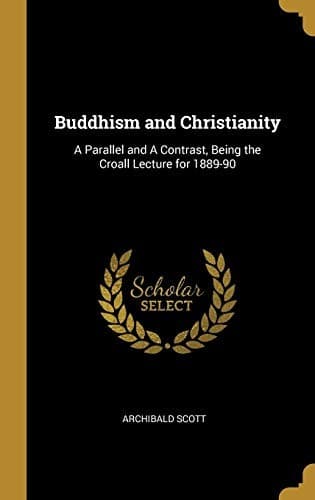
Buddhism and Christianity: A Parallel and a ContrastScott, Archibald
Religion
Buddhism and Christianity: A Parallel and a Contrast
Scott, Archibald
Buddhism -- Relations -- Christianity; Christianity and other religions -- Buddhism
This was quite in keeping with the Buddhist conception of deliverance.
The Sangha simply was an attempt to realise the idea and purpose of the
creed. Salvation according to Christ meant rescue from the power of
evil, but not withdrawal from the world as so incurably evil that the
sooner man got out of it the better. Instead of making His Church an
asylum and refuge from the world, He organised it for the redemption of
the world. Instead of attempting to destroy civil society, He aimed at
its purification by the leavening influence of the new society which He
was creating. The Church was to be Christ’s witness when He was no
longer visible, the instrument by which His own power would bear upon
the wants of mankind. The slavery and the degradation of society, the
destruction of the world, was never meant to be the condition of the
existence or of the liberty and dignity of the Church. It was but a
means to an end, a means so essential that without it the end could not
be reached, but, once the end has been reached, the Church will be
superseded, or rather will be merged in the kingdom of God. So the very
symbol of it is not found in the apocalyptic visions of the new heaven
and the new earth. In the civitas of the new Jerusalem St. John saw
families and nations and kingdoms, but he could see no temple therein,
for the instrumentality of which the temple was the symbol had done its
work in the emancipation and education of the human race, and had
vanished into the more glorious and eternal realities of the throne of
God and of the Lamb.
In Buddhism we find a set of ideas quite contradictory to all these. The
Sangha was the vehicle of rescue from out the world, not the bringer of
salvation to it; it worked not for the regeneration of society, but for
its disintegration and destruction. It considered the world to be so
hopelessly incurable, and even existence to be so weighted with misery,
that wisdom would move men to abandon the one to its fate, and goodness
impel them to strive to bring the other to an end. The monastery,
therefore, was naturally its loftiest conception of the Civitas Dei, and
into that it endeavoured to transform as large a section of humanity as
was inclined to accept its law.
Public-domain text, read in full here on John Shaqi.
Reviews
Reviews
No reviews yet
Be the first to share your thoughts on this work.
Elsewhere in the archive
Join the Discussion
Join the discussion
Sign in to leave a comment or review.
Sign InorCreate an account