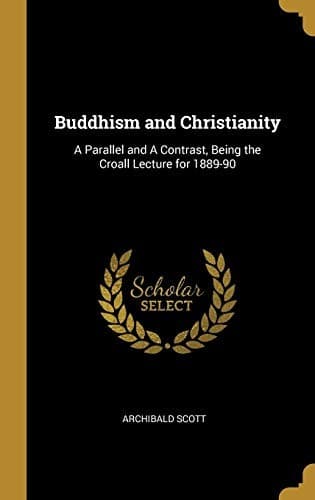
Buddhism and Christianity: A Parallel and a ContrastScott, Archibald
Religion
Buddhism and Christianity: A Parallel and a Contrast
Scott, Archibald
Buddhism -- Relations -- Christianity; Christianity and other religions -- Buddhism
This unnatural theory of life indicates the essential weakness of
Buddhism, and makes its history very instructive to Christians. In the
Church, perhaps, room may be accorded to the monastery and convent, as
long as they are sanctified by the Christian idea of self-abnegation in
the service of others, but the attempt to transform the Church into a
monastery, dominated by the Buddhist idea of abnegation of the world for
the sake of self, can only create unmitigated evil. The effect of it in
primitive Buddhism was not only to withdraw good men from the world at
the very time when its diseased condition most required the help of
their preserving salt, but the salt itself, not being used for its
natural and proper purpose, soon lost its savour. The substitution of an
artificial for a natural standard of excellence inevitably tends to
destroy even virtue. Very soon in the Sanghas active itineracy and
devout contemplation gave way to listless indolence and enervating
reverie, and there emerged a mode of life from which the great mass of
healthy men will ever revolt, as sanctioning the idea that the more
useless we become in this world the more fitted for a better we may
safely consider ourselves to be.
The Buddhist Sangha, therefore, though in no sense resembling the
Christian Church, does resemble some of its after-growths. These,
however, must be regarded as parasitical in their nature, for though fed
by its life, they do not spring from its root. In Christianity,
Monachism represents a tendency of human nature incidental to its
development rather than the essential fruit of Christian principle; but
the Buddhist idea of a true society is one essentially and completely
monastic. This one fact is sufficient to show that the similarities
discoverable between the Buddhist and Christian institutions are more
apparent than real, while the contrasts between them are found to be
deeper and more substantial the more they are examined.
Public-domain text, read in full here on John Shaqi.
Reviews
Reviews
No reviews yet
Be the first to share your thoughts on this work.
Elsewhere in the archive
Join the Discussion
Join the discussion
Sign in to leave a comment or review.
Sign InorCreate an account