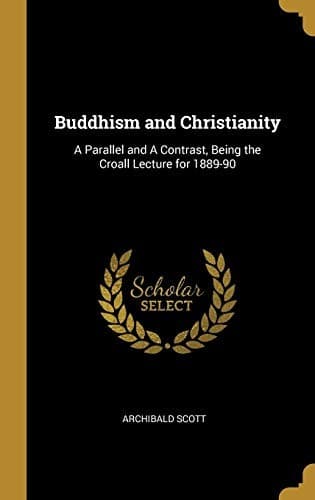
Buddhism and Christianity: A Parallel and a Contrast — John Shaqi
Buddhism and Christianity: A Parallel and a ContrastScott, Archibald
Religion
Buddhism and Christianity: A Parallel and a Contrast
Scott, Archibald
Buddhism -- Relations -- Christianity; Christianity and other religions -- Buddhism
There is yet another characteristic of this religion which has commended
it more to the unbelief than the belief of our age. Many agreements are
alleged to subsist between the contents of the New Testament and those
of the sacred books which profess to record the life and express the
teaching of Buddha. Its ancient Pitakas are said to be filled with
stories resembling the narratives of the Evangelists, with sayings which
recall the parables, and miracles reflecting the signs and wonders which
signalised the ministry of Jesus. It is averred that with the single
exception of the Crucifixion—and how immense is the significance of that
exception I shall endeavour in a subsequent lecture to show,—it would be
easy to find in them a parallel to almost every incident related in the
Gospel. Most startling of all are said to be the resemblances between
the central figures in both sets of scriptures. For Buddhism, as truly
as Christianity, has its ideal of a perfect human life, illustrated in
one who, like unto the Son of Man, went about doing good, and enforcing
by his example the pure morality which he preached, but who, most unlike
the Son of Man, without any sustaining belief in deity, or hope of
sympathy or help from any divine being, professed to have made good his
own salvation, and to teach all whom he could reach the way to work out
theirs.
When we come to examine its history, we find that it has followed a line
of development strikingly parallel to that of Christianity, and the
parallels thus furnished by its antecedents and progress, and by the
external and foreign influences which encountered and modified it, are
those which have the most interest and instruction for the student of
Religion. In order, however, to ascertain their significance, we must
examine these alleged correspondences of story and of doctrine; for
these have powerfully influenced a certain class of thinkers, as
supplying confirmation of a charge brought against our religion in
almost the beginning of its history, that after all there was nothing
original in Christ, and nothing new in His teaching. That resemblances
do exist, not only between the forms in which Buddhism confronts us in
some quarters of the world and the ritual and organisation of a large
section of the Christian Church, but between the contents of the
Buddhist scriptures as we have them now, and those of the New Testament,
all must admit. As we cast a hasty and general glance over them we see
how natural and how pardonable was the old rough and ready method of
accounting for them by the supposition of direct transference of the
various lineaments from the one to the other. The early Jesuit
missionaries did not hesitate to assert that the Buddhists, by
assimilating and incorporating the rites and doctrines of the primitive
missionaries, had succeeded in producing a caricature of Christianity.
In like manner, when in Central America—till then as independent of
Public-domain text, read in full here on John Shaqi.
Reviews
Reviews
No reviews yet
Be the first to share your thoughts on this work.
Join the Discussion
Join the discussion
Sign in to leave a comment or review.
Sign InorCreate an account