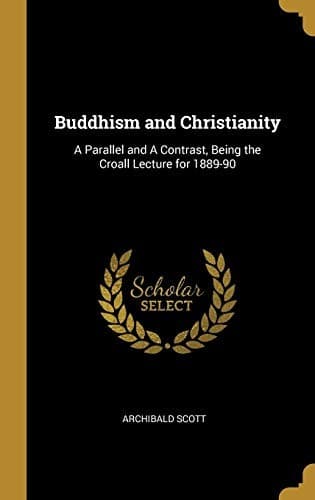
Buddhism and Christianity: A Parallel and a ContrastScott, Archibald
Religion
Buddhism and Christianity: A Parallel and a Contrast
Scott, Archibald
Buddhism -- Relations -- Christianity; Christianity and other religions -- Buddhism
So though it spread, it was not as a contagion of health, but as an
infectious disease, whose evil effects are traceable in the decrepitude
which the Oriental Church has never been able to throw off.
In the Western Church, Monachism, though less brilliant in its
beginnings than its Eastern precursor, has had a longer and healthier
course. It is not within the scope of this lecture even to sketch it, or
to analyse and tabulate its results. We live in an age which has
certainly little sympathy with the ideal of Christianity which it sought
to realise, but that is not sufficient reason that we should affect to
despise it, or imagine that we have outgrown the necessity for it. The
life of the recluse may be beyond our attainment, for we may be so
afraid to be alone, and so unable to endure “conversation with
ourselves,” that we have to take refuge in perpetual society. The
“weakness” of the old asceticism many of us have not the strength to
practise, for we are too much under the dominion of the flesh, which
they at least could master, and we are far too inclined to treat with
unnecessary tenderness what they chastised and immolated. The vows of
poverty and obedience and chastity may be the very medicine we require,
in a condition of public sentiment so unhealthy that a man’s standing,
and worth, and even life, seems to consist in the abundance of his
goods, and his freedom in licence to despise all authority and indulge
all his likings. No doubt, in the West as in the East, Monachism
eventually became an impediment to Christian civilisation, but not until
it had considerably regenerated and uplifted it. It kept before the
Church the dignity of manual labour, it wiped out the discredit
attaching to honest poverty, it proclaimed the equality of men by
treating rich and poor alike, and it proved the defender of the
oppressed, the mediator between the strong and the feeble. “We are the
poor of Christ,” says Bernard, “and the friendship of the poor makes us
the equals of kings.” Then just as unquestionably it was the pioneer of
learning and of enterprise, the guardian of law and the fosterer of
charity. There is hardly a city or populous centre in Europe which does
not owe its churches, universities, hospitals, charitable institutions,
either in their origin or growth, to the cœnobites and celibates of
former ages; and whether we acknowledge or repudiate our debt to them,
“its magnitude confronts us more imposingly the more we honestly
consider it.”
Public-domain text, read in full here on John Shaqi.
Reviews
Reviews
No reviews yet
Be the first to share your thoughts on this work.
Elsewhere in the archive
Join the Discussion
Join the discussion
Sign in to leave a comment or review.
Sign InorCreate an account