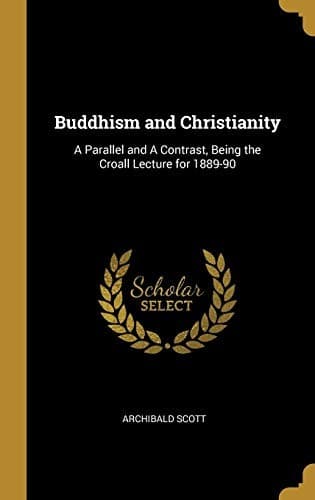
Buddhism and Christianity: A Parallel and a ContrastScott, Archibald
Religion
Buddhism and Christianity: A Parallel and a Contrast
Scott, Archibald
Buddhism -- Relations -- Christianity; Christianity and other religions -- Buddhism
and purify the world.”[265] As long as monks were truly prayerful, and
nuns, like vestals, kept alive the sacred fire for every hearth, they
represented that side of the Church’s mediation which is most important
and effective; for no one can be really effective in the service of man
who is not frequent in the service of waiting upon God. The heroes of
the Christian Church, who have evangelised and civilised the wild waste
places of the world, who, like the apostle, laid aside every encumbrance
to run their race, were, like the apostle, men of much meditation and
prayer. We have no such examples in Buddhism, for it lacked the
provision which alone could nurture them. In the life of the Buddhist
monk there was probably more, and more intense meditation than in that
of the Christian, but there was a vast difference in their respective
themes of meditation. The Christian could draw his inspiration from a
source far higher and purer than himself, and in communion with the
Father, Redeemer, Sanctifier of his spirit gather a strength which
astonished the world; but what possible inspiration for endeavour could
come to a poor Buddhist monk who was chiefly occupied in contemplating
the impurity of his perishable body, and whose very highest theme of
meditation was simply “nothing whatever”?[266]
Another essential distinction between the two modes of life is disclosed
in their relation to charity. We have seen that Buddhism had no
conception of charity in the Christian sense, and that practical charity
in it was represented from a pole quite opposite to that of
Christianity. As if conscious of its defects, later Buddhism originated
faith in and hope of Maitreya, the Buddha who is next to come, and who,
as the son of love, will realise its unconscious prophecies, fulfil its
longings, and perfect all things; but notwithstanding this the Buddhist
monk continued to be the receiver, not the dispenser, of charity. His
whole merit consisted in taking what it was the merit of the layman to
offer him:[267] and the taking was all for himself and for his Order. He
had no conception of the life suggested in the saying, “As poor, yet
making many rich,” and he never could have said of his monastery that it
was “l’infirmière des pauvres.” To offer charity to others was the last
conception which he could form of his duty: yea, to clothe the naked,
take the leper from the dunghill, and help the outcast, was the very
reverse of his duty. His creed as to misery in this being the fruit of
evil done in a former existence, cut him off from that service of the
lost and fallen which in Christendom has been accounted glorious, and
for the rendering of which, several of its monastic institutions have
been spared the penalty of their corruption.
Public-domain text, read in full here on John Shaqi.
Reviews
Reviews
No reviews yet
Be the first to share your thoughts on this work.
Elsewhere in the archive
Join the Discussion
Join the discussion
Sign in to leave a comment or review.
Sign InorCreate an account