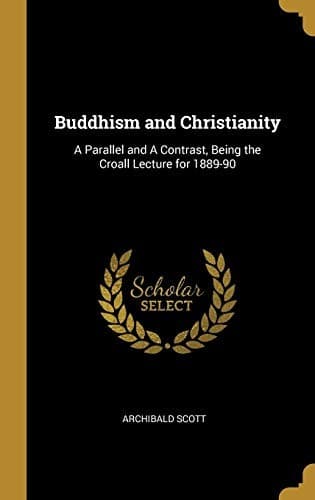
Buddhism and Christianity: A Parallel and a ContrastScott, Archibald
Religion
Buddhism and Christianity: A Parallel and a Contrast
Scott, Archibald
Buddhism -- Relations -- Christianity; Christianity and other religions -- Buddhism
But it was not so in Buddhism. Its lay associates, however numerous,
were but the fringes of religious communities essentially and wholly
monastic. When, therefore, deterioration or degradation in the Order set
in, reformation of it by the people was hopeless. In the Order this
deterioration showed itself earlier that its dominant ideal was lower
than the Christian. In early Christian Monachism, fortitude and devotion
all sprang from the immolation of self for the universal good. In
Buddha’s Sangha, however, though there was both devotion and fortitude
displayed, the goal to be reached was simply self-rescue. Its course of
beneficence therefore was not only shorter but shallower.
Unintentionally it wrought out social reforms, and perhaps political
revolution. It restrained luxury, and checked the unbounded sensuality
to which Indians are prone; it rebuked the earthly-minded, and witnessed
nobly of the higher interests of life to peoples that sorely needed the
testimony. It not only propagated morality, but promoted learning, and a
love of the beautiful in nature and art, but its force was eventually
exhausted. Very early it sank into the stagnation in which it has
existed for centuries, and any advance registered by the nations among
whom the institution has existed has been due, for more than a thousand
years, to the influx of Christian ideas and sentiments.
Its own methods hastened its decay. Like all Eastern religious growths,
it represented the piety of inertion. Manual labour of all kinds was
placed under the ban, and beyond attending to the cleanliness of his
person and of his lodging the Buddhist monk was not allowed to do
anything save itinerate for his maintenance and the preaching of the
law. He was instructed that every moment abstracted from meditation was
serious loss. This was in direct contradiction to the very first rule of
Christian solitary life, which even in the stifling heat of the desert
demanded manual tasks, which fasting might be said to have doubled,
continued through the long day till vespers summoned the labourers to
worship. The Buddhist monk knew neither the healthy life of physical
exertion nor the spiritual refreshment of worship. He might vindicate
his idleness against the reproaches of the industrious by the assertion
that he too in his quiet life was also “ploughing and sowing” to much
better purpose,[263] but then the effect of his ploughing and the fruit
of his sowing were all confined to himself, who alone was freed by it
from suffering. He could not answer, as the Nicæan monk and quondam
courtier replied to Valens, when challenged as to whither he was going,
“I go to pray for your empire.”[264] Augustine has indeed assured us
that “the less a monk labours in anything but prayer the more
serviceable he is to men”; but the prayer which he had in view was not
selfish. On the contrary, the tears and penitential exercises of men who
had become strangers to all personal desires “were mighty to drown sin
Public-domain text, read in full here on John Shaqi.
Reviews
Reviews
No reviews yet
Be the first to share your thoughts on this work.
Elsewhere in the archive
Join the Discussion
Join the discussion
Sign in to leave a comment or review.
Sign InorCreate an account