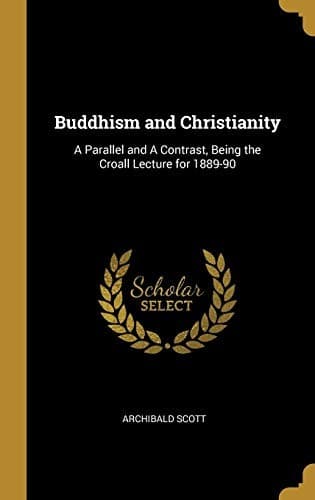
Buddhism and Christianity: A Parallel and a ContrastScott, Archibald
Religion
Buddhism and Christianity: A Parallel and a Contrast
Scott, Archibald
Buddhism -- Relations -- Christianity; Christianity and other religions -- Buddhism
The early scriptures of Buddhism, though preserving a tradition that in
twelve years from the time in which the doctrine was first preached it
had spread over sixteen kingdoms, disclose no such rapidity of
diffusion. The kingdoms referred to are not to be regarded as kingdoms
in our sense of the word, for in extent and influence they would not
equal a German principality, and were probably only tribal communities.
After the death of Buddha the many Sanghas that had arisen seem to have
suffered for lack of a central governing power. If his Order is to be
called a Church, it had manifestly no church-government. It had synods,
and assemblies, and councils, but not one with the authority of an
Œcumenical as representative of the whole. It was more Congregational
than Presbyterian in its constitution, and for this very reason it was
weak when compared with the compact organisation of Brahmanism, with
which it competed for supremacy. Disorder and dissension are traceable
in it from the first, and the early texts, though containing many
admonitions against schism, warnings that offences must come, and woes
upon those who would cause them, record no practical steps to prevent or
remedy them.[329] Vigorous expansion was consequently not to be looked
for, and for two centuries we may safely infer that Buddhism represented
only a struggling sect, which, beyond the limits in which it was first
preached, had made little, if indeed any, progress.
At the close of this period, when its literature was reaching a
canonical form, and its manuals of discipline and common order were
generally in use, it found its Constantine in the conqueror
Chandragupta. In opposition to the Brahmans, who despised him for his
low-caste origin, he seems to have lifted it from obscurity into the
sunshine of really imperial favour. His grandson Asoka, who consolidated
his conquests, proved its Theodosius, in not only greatly endowing it,
but in establishing its supremacy. There were no quarrels between him
and the Sanghas as to their independence, as afterwards between the
Emperors and the Popes, for, like a true son of the Church, he
acknowledged their authority. By obeying in appearance, he in reality
became, what Buddhism since the death of its founder sorely needed, the
head of the system, and under his wise and energetic rule, the religion
emerged into a vigour which it was to maintain for centuries.
Public-domain text, read in full here on John Shaqi.
Reviews
Reviews
No reviews yet
Be the first to share your thoughts on this work.
Elsewhere in the archive
Join the Discussion
Join the discussion
Sign in to leave a comment or review.
Sign InorCreate an account