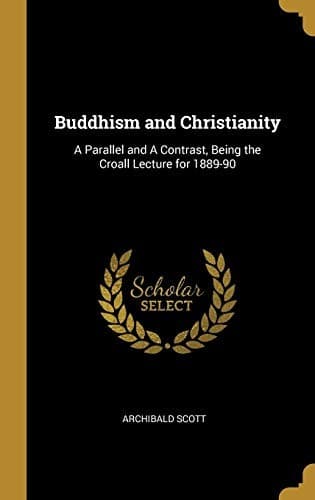
Buddhism and Christianity: A Parallel and a ContrastScott, Archibald
Religion
Buddhism and Christianity: A Parallel and a Contrast
Scott, Archibald
Buddhism -- Relations -- Christianity; Christianity and other religions -- Buddhism
and the monotonous and stagnant type of humanity which his teaching has
produced may be a warning of the kind of civilisation which the world
may expect should ever philanthropic secularism supplant or supersede
the religion of Christ.[375]
Contemporary with Confucius, though much older in years, was Lao-tsze
the Venerable, the author of the celebrated Tâo-teh-King, in which not
only Romish missionaries but scholars like Montucci of Berlin (1808) and
Remusat[376] (1823) professed to find the mystery of the Holy Trinity
and the name of Jehovah phonetically expressed. Twenty years later
Stanislas Julien[377] dispelled these illusions, and showed that the
treatise was as agnostic in its essential teachings as were the Analects
of Confucius. A poet and a mystic, he gave his whole strength to enforce
the virtue of Tao—the _way_[378] of man’s return to that spontaneity of
action without motive which prevails in nature, and which will manifest
itself in man, in humility, gentleness, refusal to take precedence in
the world, in accounting the great as the small, the small as the great,
and _in recompensing injury with kindness_.[379] He does not affirm the
existence of God, but he does not deny it, and his language seems to
imply it. Certainly there is not a word which savours of superstition,
and yet he is the reputed founder of a most idolatrous religion, which
is found in shape five centuries after his death. The works of his
earliest followers are said to be full of the most grotesque and absurd
beliefs. As early as 221 B.C. some of them were in search of the Eastern
Hesperides, where grew the herb of immortality. In the first century
A.D. another professor of Taoism invented a pill containing the elixir
of life, and spells which could tame and destroy by the touch of a
pencil millions of demons. All through its history it has been a
conglomerate of superstitions so base, and so contrasted with the
teaching of the Tâo-teh-King, that to make the author of that literary
relic bear the obloquy of even the slightest connection with Taoism,
appears to be one of the grossest wrongs of history.[380]
Public-domain text, read in full here on John Shaqi.
Reviews
Reviews
No reviews yet
Be the first to share your thoughts on this work.
Elsewhere in the archive
Join the Discussion
Join the discussion
Sign in to leave a comment or review.
Sign InorCreate an account