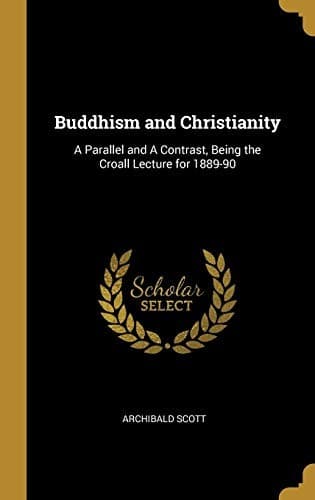
Buddhism and Christianity: A Parallel and a ContrastScott, Archibald
Religion
Buddhism and Christianity: A Parallel and a Contrast
Scott, Archibald
Buddhism -- Relations -- Christianity; Christianity and other religions -- Buddhism
These sages preceded Buddha by a century, whose religion, though it came
into contact with China shortly after the reign of Asoka, did not
seriously begin to influence it till about the fourth century A.D. The
Buddhism of that period was the religion of the Northern school, well
advanced in its second stage of degeneracy. Wherever it was encouraged,
or allowed to maintain itself, it reared monasteries and nunneries,
temples and shrines of idols and relics, and established the worship of
saints and images, which sometimes, like winking Madonnas, opened their
eyes and otherwise worked miracles. Its effect upon Taoism was simply to
absorb it; for before then that religion had neither monasteries nor
temples, nor any system of worship. All these it borrowed from Buddhism,
whose Triratna and endless pantheon of deities it greedily accepted,
with the effect that though Taoism has existed nominally distinct from
Buddhism in China, it has simply been as Buddhism in a native dress, and
thus far the Hindu mind can be truly said to have powerfully influenced
Chinese thought.
By the Confucians the reception of Buddhism was very different. They
might have laughed at its idolatrous system budding vigorously into
life, but they could not endure its full-blown anti-social Monasticism.
Its morality they could appreciate, though it seemed inferior to their
own; for though its teaching as to future rewards commended itself to
the moral instincts of the masses, the Confucians, more logical than
Buddhists, averred that to avoid wrong-doing for fear of future
punishment was not doing right for its own sake; while to labour for
happiness hereafter led to neglect of the present, and promoted lazy
inactivity. Such a scheme of religion was by them judged inimical to
virtue, which was its own reward, and the manner of life by which it was
illustrated was condemned as particularly immoral. The State, the
Family, Society, were Divine institutions which ought to be maintained
and perfected. Industry, public and private, was essential to their
ideal of propriety; and Buddhism, with its religion of inaction, its
celibate rule, and abandonment of all secular business, was simply
odious to the instincts of a practical and kindly people. There could
only be war between two such contradictory systems—a war not of words,
but, on the Chinese side at least, of very hard blows. Their hostility
manifested itself in repeated and prolonged persecutions. In one of
these 250,000 monks and nuns were forced to return to social life, while
their property was confiscated, and the copper of their images and bells
was minted into coin. The Confucians have long ceased to persecute, but
they have never withdrawn their first indictment against the Buddhists
for teaching what to them is criminal because disloyal, and immoral[381]
because anti-social.
Public-domain text, read in full here on John Shaqi.
Reviews
Reviews
No reviews yet
Be the first to share your thoughts on this work.
Elsewhere in the archive
Join the Discussion
Join the discussion
Sign in to leave a comment or review.
Sign InorCreate an account